On the sixteenth of every month, Digging hosts Foliage Follow-up so that we can explore our garden's non-flowering aspects. I have reached the conclusion that in a shady garden, it is the leaves that rule. So here are a few of my May garden leafy stand-outs.
Raspberry Ice Coral Bells (Heuchera 'Raspberry Ice') actually still has a few blooms hanging in there, but its foliage is the main show. The leaves emerge small and reddish deep within the plant, then push out and change to the nicely variegated pattern that lightens up the dappled shade area.
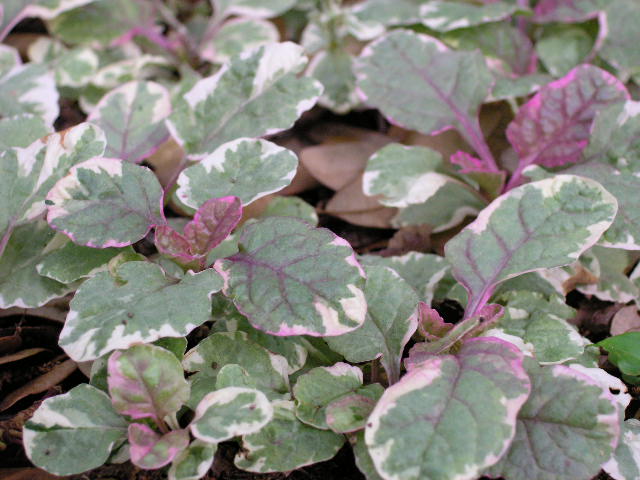
Of course, if variegation is what you desire, the Strawberry Geranium (Saxifraga stolonifera) definitely catches your attention. Spreading out like a slow moving groundcover, it has finished its bloom cycle, but still contributes to the show with its leaves.
Burgundy Glow Ajuga (Ajuga reptans 'Burgundy Glow') is another that brightens the darker areas of the shady garden. In my garden, it seems to grow much slower than regular Ajuga, gradually weaving its way in and around other larger plants but never forming thick mats. Really enjoy the lighter colors and purplish highlights.
Another bright spot in the shade is the Ghost Plant (Graptopetalum paraguayense). With a little bit of protection, it survived this winter's 18 degree lows with only minor damage. And now it is again growing, producing new leaves as it cascades out onto a nearby stone path.
Have been enjoying a new addition to this year's garden, the Agave 'Blue Glow'. Its blue-green, red-edged leaves have the typical agave attention-grabbing spine at its tip (it quickly trains you to move carefully around it). It has been producing new leaves from the center that stretch upward then fall outward to join the rosette, their tight initial growth producing patterns still etched on the newly opened leaves.
It all starts with the foliage; hope your garden's flavors of green are bringing you smiles.
Sunday, May 16, 2010
Saturday, May 15, 2010
Flower Power: GBBD May 2010
May Dream Gardens hosts Garden Blogger's Bloom Day every month. Blooms in my May shady garden tend to be scattered individuals, but its still fun to see the small splashes of colors. Here's what is blooming in my garden:
New Plants in the Garden
Established Plants
Annual
Potted Plants
Hope you are enjoying your own bloom day!
New Plants in the Garden
Anthony Waterer Spirea (Spiraea x bumalda 'Anthony Waterer') may need a little more sun and acid than it is getting presently, but it still put out a few clusters of flowers.
Goldmound Spirea (Spiraea japonica 'Goldmound') still has a few faint pink clusters also.
Dyckia fosteriana, growing right at the base of a Red Oak, produces blossoms that are actually more orange than shown in the picture.
Pink Shamrock (Oxalis crassipes 'Rosea') is constantly producing additional little pink blooms.
My other shamrock, White Shamrock (Oxalis crassipes 'Alba'), doesn't seem to make as many blooms, but still manages to put out some.
Established Plants
Texas Betony (Stachys coccinea) has finished its primary bloom cycle, but still has a few blossoms here and there.
Cedar Sage (Salvia roemeriana) continues to throw out vertically challenged bloom stalks.
'Ragin' Cajun' Ruellia (Ruellia elegans 'Ragin' Cajun') has re-emerged from underground; still getting this year's growth started, it also managed to throw out a couple of blooms.
If my memory is correct, Red Dragon Knotweed (Persicaria microcephala 'Red Dragon') mainly produces its blossoms in the fall. But a few are appearing here in the spring.
Yeah, I know. It's bad, it's evil. But Nandina domestica grows & blooms in my shade, and its red berries in the fall are lovely.
Annual
The bronze-leafed begonias (Begonia x semperflorens-cultorum) continue to explode in pink blossoms. I'm not too big on annuals, but I can't pass up the begonia's zealous bloom production.
Potted Plants
The Chrysanthemum still puts out a flower now and again.
The Red Yucca's (Hesperaloe parviflora) bloom stalk has skyrocketed upward, and is now unfurling its limbs of red blooms.
Bear's Breech (Acanthus 'Summer Beauty') is sending up two flower spikes which tend to last quite a while. The unique blossoms occur at almost symmetrically precise steps along the stalk.
Hope you are enjoying your own bloom day!
Thursday, May 13, 2010
Hummingbird Nest
Finally decided to try and get a peek into the hummingbird nest. The nest is directly above the driveway and isn't that high, but I ended up needing to place a ladder into the bed of my truck to get enough height. Then it required attempting various yoga positions to maneuver my head and shoulders through the twigs and limbs. But I was finally able to get a peek into the nest.
Thought I'd be seeing some eggs, but instead discovered two fluffy nestlings inside. The baby birds didn't look like much - more look two fuzzy patches in the bottom of the tiny nest that twitched occasionally. They can barely be seen in the picture: the small bits of hair-like feathers barely visible in the center of the nest edge is them.
As I've only seen the female, I haven't been able to determine whether its a Black-chinned Hummingbird or a Ruby-throated Hummingbird (both are known to nest in central Texas).
So far this year, I've discovered nests in my yard for Carolina Chickadee (bird house), Tufted Titmouse (attic ventilation slats), White-winged Dove (Boxwood) and hummingbird (Oak). It's been a good year for the birds.
Thursday, May 6, 2010
A Hole In The Canopy Means...
Late last fall, one of my trees collapsed, removing both itself and another from my shady canopy. Suddenly, a limited area of my yard was receiving...sunlight! Not my usual stuff the peeks in and out of the upper story foliage, but the real thing. Up to six hours of it. The mind raced with possibilities.
Fall /Winter/Early Spring - "I'm going to plant some flowering shrubs, maybe even (gasp) a rose bush! And possibly some of those flowers that are rumored to grow in these parts. And a couple of pots with Dill - perhaps I can attract those swallowtail butterflies everyone seems to have in their yards.
Today - "Oh yeah. That's right. The existing plants sorta liked the shade. And now they are getting...ummm, well, rather...cooked..."
"...and sunburned..and fried. Well, ummm...guess I kinda forgot about y'all..."
"And now its getting a little too hot to be digging up plants your size and moving you elsewhere. Sure woulda been nice to get that done...ummm, earlier. Here's a fair bit of water and, ummm, I guess, maybe, I can start building you a little shade structure to get you through till next fall...hopefully...possibly..."
A hole in the canopy means a chance to grow some sun-loving plants, but it also means you'd better start moving out the shade-loving ones.
Saturday, May 1, 2010
Autumn Ferns
The favored fern of my shady central Texas garden is the Autumn Fern (Dryopteris erythrosora).
I have tried several other fern varieties. Some were unable to handle the summer heat and drought while others were dissatisfied with my yard's low light levels. Nearly all would disappear back to the ground after the first frost - returning diminished the following spring or never appearing again at all.
But the Autumn Fern hasn't disappointed. It begins spring by sending up several reddish fiddleheads which slowly unfurl to present rusty colored fronds. The fronds gradually lose their reddish hues as, over several weeks, they change to green.
They are more drought tolerant than many fern varieties, surviving on the same level of watering as most lawn grasses. And either early morning sunshine or all day filtered sunlight meets its light needs.
And come winter's freezes, the Autumn Fern stays evergreen, its fronds withstanding our past winter's 18 degree lows with little or no damage.
With evening coming on, the sunshine angles through the trees and backlights the raised fronds.
Sunday, April 25, 2010
Week In The Garden
Earlier in the week, I realized that my presence was agitating a hummingbird in the tree above me. After a few minutes of observation, I discovered that the little female was building a nest. She'd zip in with a tiny piece of white fluff held in the tip of her bill, land on the nest, do some quick actions, then buzz away again. The picture isn't sharp, but that's her sitting in the nest in the center of the photo. This is the first hummingbird nest I've ever discovered in the yard.
Back to its original location from last year, I planted one of the cuttings I made from the Beefsteak Plant (Perilla 'Magilla') in one of the front yard beds. It did quit nicely there previously, growing to almost four foot. Here's hoping I get the same results this year (and I've still got more cuttings to try elsewhere).
Finally changed the status of my two Mexican Turk's Cap (Malvaviscus arboreus var. mexicanus) from dormant to dead. Same is also true of a few plants that were transplanted right before the big freezes hit: Coral Nymph Sage (Salvia coccinea 'Coral Nymph'), Smooth-Leaf Sage (Salvia miniata) & Pink Dianthera (Dianthera candicans). I guess the winter's 18 degrees was just too low or too soon.
So in to some of these vacant spots (plus some that were empty to begin with), I did some planting. A Giant Spiderwort (Tradescantia gigantea), already looking wilted, went behind some Liriope. Three Red Columbine (Aquilegia canadensis) and three Lyreleaf Sage (Salvia lyrata) went into the backyard beds. Have tried both with limited to no success in the past, but it appears the time has come for another attempt.
Been on the lookout for Husker's Red Penstemon (Penstemon digitalis 'Husker's Red'), and I finally captured this elusive quarry. Really like the red coloration in the leaves, and I'm hopeful that it will bloom as well my other penstemons.
In a deeply shady section, where it can cascade over some railroad ties, I'm trying the Spreading Plum Yew (Cephalotaxus harringtonia 'Prostrata'). It is supposed to do well even in significant shade, so I'm interested to see how it does for me. The picture was taken during the sunniest part of the day for this spot: it gets maybe 1-2 hours of dappled light and then no direct sun the remainder of the time.
To fill in the holes made by the deceased Mexican Turk's Caps, I'm trying two plants that are new to my shady garden: Goldmound Spirea (Spiraea japonica 'Goldmound') & White Margin Snow Rose (Serissa foetida 'Improved').
The Goldmound Spirea is covered in chartreuse foliage which really stands out in the dappled shade. It presently has several unopened buds destined to be clusters of tiny light pink flowers. Wouldn't be surprised if this is the only year it blooms, but I'm mainly interested in those neon leaves anyway (though I certainly wouldn't turn away any returning blooms!).
I was completely unfamiliar with White Margin Snow Rose, so this was a nice discovery. The small variegated leaves are joined by occasional tiny white blossoms. But, again, its the foliage that steals the show.
Beautiful weekend to be in the garden...
Wednesday, April 21, 2010
Cedar Sages Take a Bow (Sadly)
My garden's three Cedar Sages (Salvia roemeriana) came back strong this year, rising up from the ground and then throwing out stalks of brilliant red flowers beside the backyard path.
Then came last week's rains. And the Cedar Sages took an unfortunate bow.
I believe the same thing happened last year. Does this happen to your Cedar Sages?
There must be a trick to keeping them upright. I guess I need to be more proactive. Perhaps some type of bloom stakes or grow-through supports? Maybe etiquette lessons on proper posture?
And what to do post-collapse? Enjoy the brilliant, though vertically challenged, flowers? Snip them off and transfer them to a vase? I assume snipping will encourage additional blooms.
I guess I'll look at this as an opportunity to bring some fresh cut flowers inside the house...
Subscribe to:
Posts (Atom)