Showing posts with label Pittosporum. Show all posts

Sunday, October 7, 2012

Planting Plants

Now that cooler weather has arrived (at least for the weekend), spent some time putting plants in the ground or transplanting them to new locations.

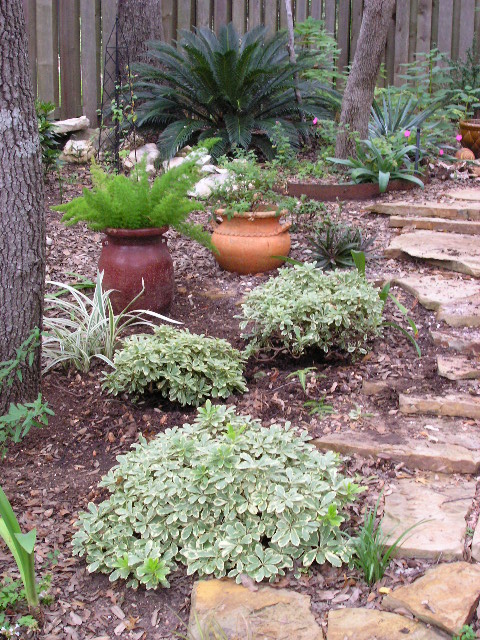
Added two more Pittosporum Creme De Mint (Pittosporum tobira 'Shima') along my backyard path.  Have actually had these since late spring and have been babying them in their pots over the summer - glad to finally get them in the ground (before & after shots).
 

Transplanted my Red Billbergia (though bought under this name, I'm beginning to think it's actually Cryptbergia 'Red Burst) from where it was getting buried by a nearby Rattlesnake Agave (Manfreda maculosa) to a more prominent location where its bright red coloration will get more noticed.  Also moved several Friendship Plants (Billbergia nutans) from a front bed back here into the tier behind the Red Billbergia.

Moved several Soap Aloes (Aloe maculata) pups into the top tier of my Three Tiers Garden.  Presently have one blooming and at least three others in the process of sending up bloom stalks - which will be their best showing ever.

Sunday, May 8, 2011

Been A While

Time in the April garden seemed to sneak by without me.  Except for snipping Live Oak root sprouts, my activity during this typically nice gardening period was limited.  A busy personal schedule, drought conditions and early high temperatures conspired to keep me from accomplishing much - both in the yard and in the blog.

But there have been some stirrings in the garden.  Recent minor rains at least got the Pink Rain Lilies (Zephyranthes rosea) perked up.  A single specimen produced a nice blossom...

...with a larger patch holding the promise of additional blooms.

Planted in February, the Wall Iris (Iris tectorum) started producing its exotic blooms.  However, the flower stalks tend to sprawl - falling off to the side.  Thus the blooms are not visible unless standing directly beside the plant.

A couple of potted plants are showing some color.  The Orange Kaffir Lily (Clivia miniata) has been pretty reliable - producing a stalk of brilliant orange blooms every year.

My only "typical" cactus, the Peanut Cactus (Echinopsis chamaecereus) is topped by a single red flower.  The bloom does not last long, and only occurs sporadically - so its always a nice surprise when it blossoms.

Nearly a month before, during a tour of Pam Penick's garden (of Digging fame), I saw her Pittosporum Creme De Mint (Pittosporum tobira 'Shima') had already started producing significant new foliage.  Needless to say, my worry level skyrocketed - as mine was just sitting there.  And continued to do so as the weeks crept past.  But with a sigh of relief, I can report that mine finally started producing bright green new growth.

After a brief respite, temperatures are again climbing.  The drought continues.  And the garden persists.

Sunday, February 6, 2011

Uncovering The Plants

Unwrapping the plants from their protective (ha!) covers is a bit like an evil birthday party where many of the gifts are pleasant surprises, but a few are twisted, melting, blackened carcasses.  Ooo, what fun - let's open the next one.

For this posting, I'll examine the plants which were left outside but received some form of protection.  (Will examine those left to fend for themselves on a subsequent posting.)

The Foxtail Fern (Asparagus densiflorus 'Meyersii') showed some minor damage, but actually came through in good shape (especially for a recently potted plant).

The two Sago Palms came through beautifully.  Of course, not only did they receive a cover, but a spotlight was placed underneath each one to give some additional warmth.  The light bulb trick made a huge difference.

The Dyckias are all looking a little sad - a combination of cold and cover weight.  Some of the spiky leaves seem a little more pliable than normal.  Will have to wait to see how well they recover, but I'm at least hopeful.
Dyckia 'Cherry Coke'

Red-leafed Dyckia (Dyckia 'Red Devil')

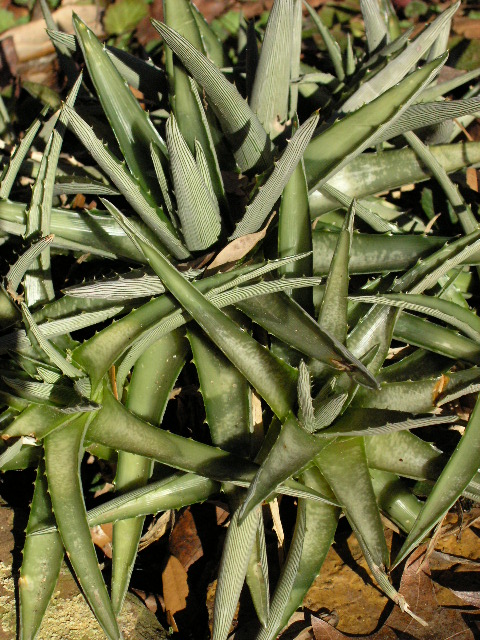
Pineapple Dyckia (Dyckia brevifolia)


Bronze Dyckia (Dyckia fosteriana 'Bronze')

Dyckia platyphylla

The Soap Aloes (Aloe saponaria) got hammered.  For that length of cold, covers made no difference.  They likely would have benefited from the addition of a light source for warmth, but that would be difficult as they are widely scattered around the yard.


But at least some of the pups appear to be firm and strong, so there is a chance some will survive and grow from these.

The Aloe 'Hedgehog' (Aloe humilis 'Hedgehog') also got hit hard.  Though it appears that some portions of the plant will likely survive, it will be significantly reduced.  In the future, my succulent bed may get its own spotlight.

In the covered succulent bed along with some of the Aloes and Dyckias, this Manfreda looks rather sad.  Species unknown, it has seemed less hardy as the 'Macho Mocha' - but the seller at the Austin Cactus & Succulent show said it would likely die back to the ground, but would return.

The Pittosporum Creme De Mint (Pittosporum tobira 'Shima') will, in the future, likely not even get covered.  It only received special treatment this winter since it was a recent transplant.  Though somehwat flattened, it appears to be in a good shape.

Much like the Pittosprum, the Sparkler Sedge (Carex phyllocephala 'Sparkler') primarily got protection due to their recent planting.  All of them came through with little or no damage.

The following seemed to have survived with varying degrees of damage:
Though difficult to burrow inside to determine, it appears that all the plants in the pop-up greenhouse have come through the deep freeze just fine.

The vast majority of my plants are typically left to fend for themselves.  In the near future, I will try to post a listing of those that show damage and those that looked bad but recovered.

Wednesday, February 2, 2011

There Will Be Damage

Many central Texas gardeners looked at last winter's 18 degree low as extreme.  So I guess this winter's freezing temperatures will have to be considered extremely extreme.  Not only have we reached 17 degree lows, but will achieve it two nights in a row.  While it is not uncommon for this area to drop pretty low, we typically bounce back to above freezing quite fast - often on the same day.  This winter is unusual for us as we are expected to remain under freezing for an extended period: over 60 continuous hours at or below freezing.


So there will be damage.  Prior to last night's freeze, I had already covered the plants (even purchasing a 10x20 foot cold cover to add to my collection of sheets, blankets & towels).  Obviously, I don't have enough to cover everything, so choices had to be made.


Covered plants include:
Then there is the inevitable plant that one forgets to cover.  This time around it was the Gasteraloe 'Midnight' - will have to wait and see what happened to it.

But several plants are already showing signs of damage.

Gold Dust Plant (Aucuba japonica 'Variegata')

 Bear's Breech (Acanthus 'Summer Beauty')

Formosa Red Azalea (Azalea indica 'Formosa Red')

Joe Pye Shrub

There are many others (but I was too wimpy to stay out in the cold taking snapshots!).  Even the Cast Iron Plants (Aspidistra elatior) have an unusual darkness to their green color.  Only time will tell which plants survive.

Planted in Pots:

Wednesday, November 24, 2010

'Gotta Get' Gotten

After reading about the dwarf variety Pittosporum Creme De Mint (Pittosporum tobira 'Shima') on the Digging garden blog, I promoted it to my 'Gotta Get' list.  But now I'm getting to remove it from the list - cause I got it!


Prior to finding the plant, I had already selected a spot for it near my garden path that needed some winter foliage and a little pizazz.  I think the Creme De Mint's variegated, evergreen foliage of light green, white & creamy pale yellow definitely fulfills that requirement.


I was able to get one that already measured a couple of feet across and a little over a foot tall, so its already at least halfway to its full size.  It'll receive late morning sun, then dappled shade the remainder of the day (hoping that will be sufficient).


One 'Gotta Get' gotten; so many more to go...

Sunday, November 7, 2010

Cyclamens

For winter color, I've decided to try Cyclamens (Cyclamen persicum) in my front yard, three-tiered bed.  My beds tend to be too shady for pansies, violas or ornamental kale/cabbage.  But on a recent episode of Central Texas Gardener, they mentioned that Cyclamens can handle shade.


To prepare the beds, I removed the existing Begonias (Begonia x semperflorens-cultorum) and then used a garden fork to break up the dirt.  Then, as I came across them, I pulled as many of the oak root sprouts as I could (which was a lot!).  Next, I added some peat moss to enrich the soil and some decomposed granite to keep it loose.  Afterwards, I worked in a generous amount of compost to give the annuals a good boost.


Finally, I planted a mixture of lighter and darker pink shades in the two lower tiers.


Though I planted 20 Cyclamens, I'm thinking I need a couple of more of the plants (darn - another trip to the store).  Hopefully, as they grow, they'll fill in the beds with some good winter color.


Gotta Get:
  • Japanese Root Iris (Iris tectorum): Have considered it for quite a while; finally decided it was one I wanted in my garden.
  • Pittosporum Creme De Mint (Pittosporum tobira 'Shima'): As this variety only grows a little over two foot is size, I'm think having one in a sunnier spot would be great (of course, "sunnier" is very relative in my garden).
  • Golden Oakleaf Hydrangea (Hydrangea quercifolia 'Little Honey'): Have just started playing with the Oakleaf Hydrangeas by having the variety 'Alice' planted.  Really like the chartreuse colored leaves on this 'Little Honey' variety, plus the fact that it tends to be somewhat smaller than many of the other varieties.