Established Plants
I was surprised to discover the Aztec Arrowhead (Sagittaria montevidensis) already had a bloom stalk developing. The first of its flowers are just opening, but it will continue growing upwards and producing additional blossoms - as well as additional stalks appearing sporadically.

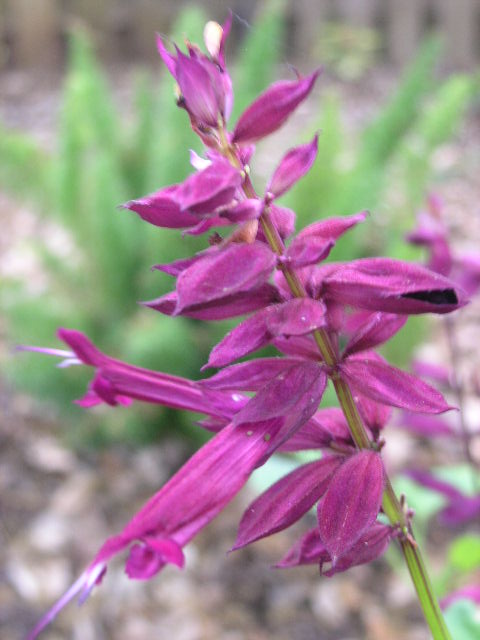
There are two aspects of Cedar Sage (Salvia roemeriana) that I really enjoy: the intense red coloration of its blooms and the way it sprouts from small crevices in my stone walkway. Eventually the plant will loose its blooms and the foliage will become unattractive, but by then its seeds will have found their way into some other crack amongst the rock - and be ready to surprise me again next spring.

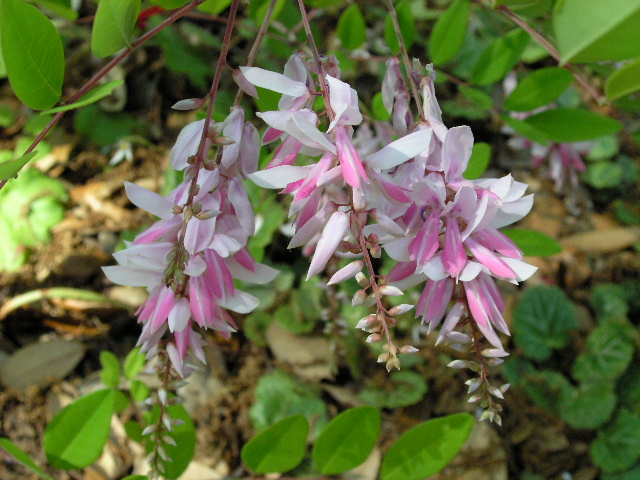
More than ever before, the Chinese Indigo (Indigofera kirilowii) is covered in the dangling, pink blossom clusters that it produces.
The blooms of the Gulf Coast Penstemon (Penstemon tenuis) have begun to fade, but for several weeks it has filled a section of the garden with its pale lavender color.

Strawberry Geranium (Saxifraga stolonifera) are just beginning to send up their diminutive bloom stalks topped with its clusters of minuscule blossoms. I have always enjoyed the intricacy of its quarter-inch flowers.

The intense color of the Pink Shamrock (Oxalis crassipes 'Rosea') flowers really stands out in the dappled shade. Though Oxalis can be considered invasive, I have found this variety to be well-behaved. Too much so in fact - as I will likely have to purchase more to add as it has not spread at all.

The Amaryllis (Hippeastrum sp.) in my garden are scattered about in small numbers - but all of them are either producing large red blossoms or have bloom stalks shooting skyward.

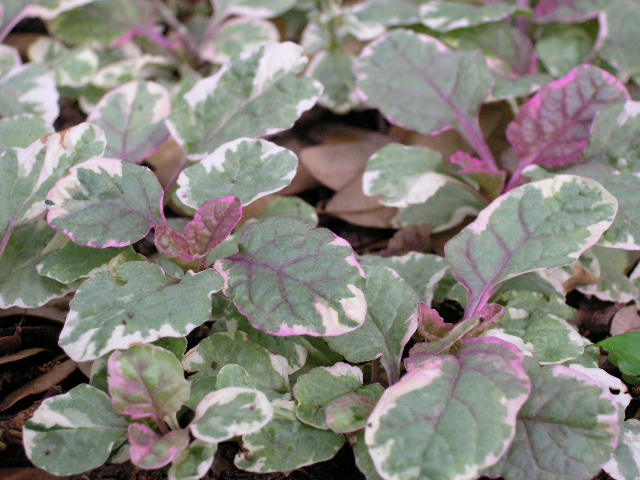
Last fall I moved the struggling White Margin Snow Rose (Serissa foetida 'Improved') deeper into the shade. It is still struggling (our ongoing drought is making things difficult for it), but still managed to produce some scattered white blooms amongst its variegated foliage.

Texas Gold Columbine (Aquilegia chrysantha var. hinckleyana) is nearing the end of its flower season - but at its peak the top of my backyard path was highlighted by a large, waving area of bright yellow.

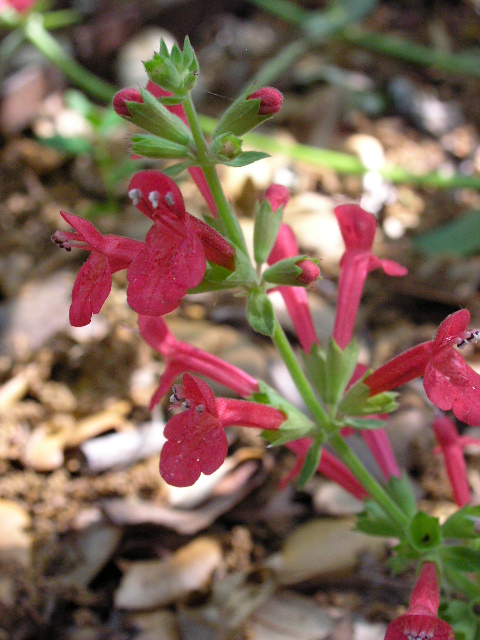
Texas Betony (Stachys coccinea) is also highlighting nice sections of my garden with its sprawling stems of dusky red flowers.
Both the fragrance and blooms of the Banana Shrub (Michelia figo) are fading - but a few flowers can still be found amongst its shiny, ligustrum-like leaves.

Most of my Ajuga blooms have faded, but the Burgundy Glow Ajuga (Ajuga reptans 'Burgundy Glow') appears to have just started. Though set back from our severe winter, it certainly can still catch one's attention with its short stalks of purple blooms.

Returning from roots, the Purple Oxalis (Oxalis triangularis subsp. papilionaceae 'Atropurpurea') is putting out several cascading clusters of pale blooms. The flowers look especially nice against the plant's dark purple foliage.

New Plants in the Garden
Recommended by Central Texas Gardener, I added the dwarf Bella Red Abutilon (Abutilon x hybridum 'Bella Red') to the garden last year. After receiving at least some cover for its first winter, the plant responded by retaining much of its foliage and has started spring off with numerous blooms. Unlike my other Abutilons, this variety appears to open its blossoms wide - though they do still tend to face downwards.

Planted less than a month ago, Trailing Violet (Viola banksii) was still able to produce a couple of flowers. The blooms really do stand out in the shade. If it handles the summer heat and spreads as reported, it could produce quiet the show next spring.

Oakleaf Hydrangea 'Alice' (Hydrangea quercifolia 'Alice') has added quite a bit of new foliage in its first spring, and is just beginning to unfurl a couple of flower clusters.

Lyreleaf Sage (Salvia lyrata) is nearly done blooming, but it made a nice little patch of color near the garden path. Though this was its first heavy bloom cycle, the few blooms it had in the fall must have scattered its seeds well - for I have seen some of its offspring sprouting from the ground, yards away.

Potted Plants
'Mrs. Pollock' Geranium (Pelargonium x hortorum 'Mrs. Pollock') has incredible foliage, but it has also been producing small clusters of bright red flowers - so my shade is getting the best of both!

Originally planted in the ground where winter hammered it, I moved my Star Begonia (Begonia heracleifolia) into a pot last fall and babied it over the winter (good thing with the severe cold we had this winter!). It has rewarded that move by producing stalks of pale pink blooms.

Indoor Plants
The only flowering plants that I have ever kept indoors are the Moth Orchids (Phalaenopsis sp.) - they live happily near a southern widow where they receive dappled shade (as does pretty much everything in my garden!). The blooms last so long, and the plants are pretty reliable in producing stalks every year.


Flower Wannabes
The slate blue berries of the Mahonia (Mahonia aquifolium) will eventually be eaten up by Mockingbirds - but for now they are attractive counterpoints to the dark green, spiky leaves.

Dwarf Buford Holly (Ilex cornuta 'Burfordii Nana') completed its early bloom cycle, and is well on its way to this fall's berry crop. Some stems have both the old and the new.

Sitting atop an empty Lyreleaf Sage bloom stalk, this ladybug seemed to want to participate in the color celebration.

Tardies
Only a few inches long, the bloom stalk of from my Aloe 'Doran Black' is just starting to grow. Soon I'll need to stalk it as it tends to grow quite thin and over a foot tall before the blooms begin to open - makng it susceptible to the slightest breeze.

Silver Squill (Ledebouria socialis) dangles loose clusters of soon-to-be flowers all about. Once open, the bees will swarm to it and the flowers will produce several seeds. Last year, as an experiment, I was able to easily germinate them and presently have a few of its young growing rapidly.

Not all the indoor Moth Orchids (Phalaenopsis sp.) were able to get their blooms ready in time. At least a few of my plants are in the early stages of developing their flower stalk - hopefully this will keep the house filled with color for months to come.

Be sure to visit May Dream Gardens to see all the spring blooms that other garden bloggers are sharing.