On the fifteenth of every month, May Dream Gardens invites us to share postings showing the flowers that are presently being found in our gardens. This year, my shady garden had more blooms than ever for spring. Gulf Coast Penstemon, Texas Betony and Texas Gold Columbine even produced swaths of color in certain areas (a first for me - typically one must crawl on hands and knees to spot the tiny blossoms found in my dappled light). By now, many have faded in our above-average heat, but I'm still enjoying the show.
Established Plants
I was surprised to discover the Aztec Arrowhead (Sagittaria montevidensis) already had a bloom stalk developing. The first of its flowers are just opening, but it will continue growing upwards and producing additional blossoms - as well as additional stalks appearing sporadically.
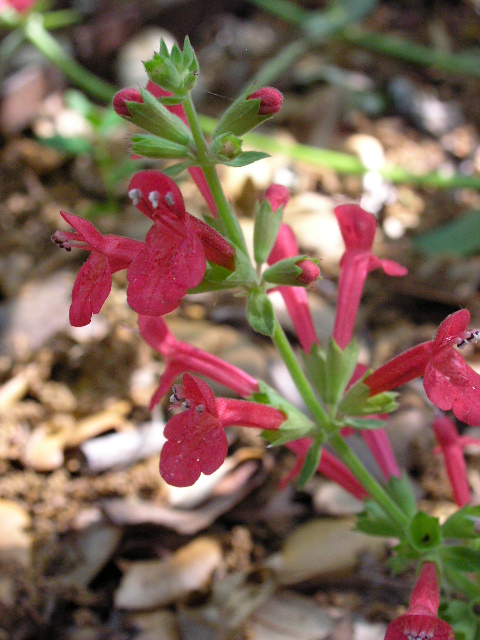
There are two aspects of Cedar Sage (Salvia roemeriana) that I really enjoy: the intense red coloration of its blooms and the way it sprouts from small crevices in my stone walkway. Eventually the plant will loose its blooms and the foliage will become unattractive, but by then its seeds will have found their way into some other crack amongst the rock - and be ready to surprise me again next spring.
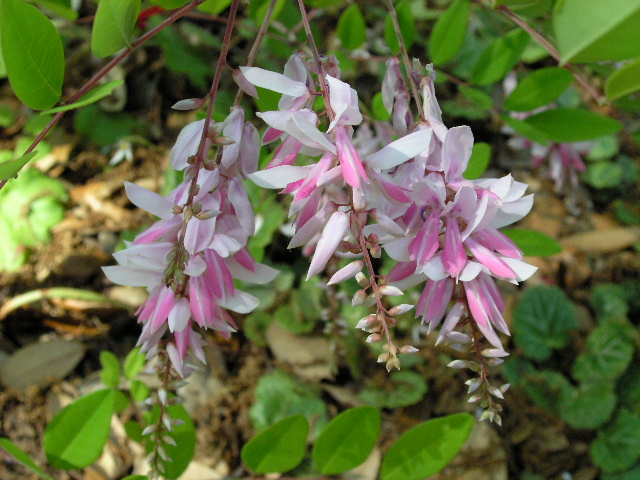
More than ever before, the Chinese Indigo (Indigofera kirilowii) is covered in the dangling, pink blossom clusters that it produces.
The blooms of the Gulf Coast Penstemon (Penstemon tenuis) have begun to fade, but for several weeks it has filled a section of the garden with its pale lavender color.
Strawberry Geranium (Saxifraga stolonifera) are just beginning to send up their diminutive bloom stalks topped with its clusters of minuscule blossoms. I have always enjoyed the intricacy of its quarter-inch flowers.
The intense color of the Pink Shamrock (Oxalis crassipes 'Rosea') flowers really stands out in the dappled shade. Though Oxalis can be considered invasive, I have found this variety to be well-behaved. Too much so in fact - as I will likely have to purchase more to add as it has not spread at all.
The Amaryllis (Hippeastrum sp.) in my garden are scattered about in small numbers - but all of them are either producing large red blossoms or have bloom stalks shooting skyward.
Last fall I moved the struggling White Margin Snow Rose (Serissa foetida 'Improved') deeper into the shade. It is still struggling (our ongoing drought is making things difficult for it), but still managed to produce some scattered white blooms amongst its variegated foliage.
Texas Gold Columbine (Aquilegia chrysantha var. hinckleyana) is nearing the end of its flower season - but at its peak the top of my backyard path was highlighted by a large, waving area of bright yellow.
Texas Betony (Stachys coccinea) is also highlighting nice sections of my garden with its sprawling stems of dusky red flowers.
Both the fragrance and blooms of the Banana Shrub (Michelia figo) are fading - but a few flowers can still be found amongst its shiny, ligustrum-like leaves.
Most of my Ajuga blooms have faded, but the Burgundy Glow Ajuga (Ajuga reptans 'Burgundy Glow') appears to have just started. Though set back from our severe winter, it certainly can still catch one's attention with its short stalks of purple blooms.
Returning from roots, the Purple Oxalis (Oxalis triangularis subsp. papilionaceae 'Atropurpurea') is putting out several cascading clusters of pale blooms. The flowers look especially nice against the plant's dark purple foliage.
New Plants in the Garden
Recommended by Central Texas Gardener, I added the dwarf Bella Red Abutilon (Abutilon x hybridum 'Bella Red') to the garden last year. After receiving at least some cover for its first winter, the plant responded by retaining much of its foliage and has started spring off with numerous blooms. Unlike my other Abutilons, this variety appears to open its blossoms wide - though they do still tend to face downwards.
Planted less than a month ago, Trailing Violet (Viola banksii) was still able to produce a couple of flowers. The blooms really do stand out in the shade. If it handles the summer heat and spreads as reported, it could produce quiet the show next spring.
Oakleaf Hydrangea 'Alice' (Hydrangea quercifolia 'Alice') has added quite a bit of new foliage in its first spring, and is just beginning to unfurl a couple of flower clusters.
Lyreleaf Sage (Salvia lyrata) is nearly done blooming, but it made a nice little patch of color near the garden path. Though this was its first heavy bloom cycle, the few blooms it had in the fall must have scattered its seeds well - for I have seen some of its offspring sprouting from the ground, yards away.
Potted Plants
'Mrs. Pollock' Geranium (Pelargonium x hortorum 'Mrs. Pollock') has incredible foliage, but it has also been producing small clusters of bright red flowers - so my shade is getting the best of both!
Originally planted in the ground where winter hammered it, I moved my Star Begonia (Begonia heracleifolia) into a pot last fall and babied it over the winter (good thing with the severe cold we had this winter!). It has rewarded that move by producing stalks of pale pink blooms.
Indoor Plants
The only flowering plants that I have ever kept indoors are the Moth Orchids (Phalaenopsis sp.) - they live happily near a southern widow where they receive dappled shade (as does pretty much everything in my garden!). The blooms last so long, and the plants are pretty reliable in producing stalks every year.
Flower Wannabes
The slate blue berries of the Mahonia (Mahonia aquifolium) will eventually be eaten up by Mockingbirds - but for now they are attractive counterpoints to the dark green, spiky leaves.
Dwarf Buford Holly (Ilex cornuta 'Burfordii Nana') completed its early bloom cycle, and is well on its way to this fall's berry crop. Some stems have both the old and the new.
Sitting atop an empty Lyreleaf Sage bloom stalk, this ladybug seemed to want to participate in the color celebration.
Tardies
Only a few inches long, the bloom stalk of from my Aloe 'Doran Black' is just starting to grow. Soon I'll need to stalk it as it tends to grow quite thin and over a foot tall before the blooms begin to open - makng it susceptible to the slightest breeze.
Silver Squill (Ledebouria socialis) dangles loose clusters of soon-to-be flowers all about. Once open, the bees will swarm to it and the flowers will produce several seeds. Last year, as an experiment, I was able to easily germinate them and presently have a few of its young growing rapidly.
Not all the indoor Moth Orchids (Phalaenopsis sp.) were able to get their blooms ready in time. At least a few of my plants are in the early stages of developing their flower stalk - hopefully this will keep the house filled with color for months to come.
Be sure to visit May Dream Gardens to see all the spring blooms that other garden bloggers are sharing.
Showing posts with label Serissa. Show all posts
Friday, April 15, 2011
Sunday, October 24, 2010
Stepping Stones
It seems to happen almost every time. I have either a new plant or an existing one in need of a new home. Nothing simpler, right? Get out the garden fork, perhaps a shovel, and simply prepare a spot for it.
And that's when the adventure begins.
On a recent excavation for a transplanted White Margin Snow Rose (Serissa foetida 'Improved'), I quickly hit stone. As usual, this led to the rock bar becoming involved. In this case, I removed a nice triangular limestone flagstone measuring almost 3 foot on the long side.
Thank goodness I got that out of the way. But what's this? Yet another rock. And it appears to be even larger. After some sweating, a second, even larger, stepping stone was produced.
This one measured approximately three foot by three foot.
Well, at least it gives me an additional step (or two) for the path that I've been working on.
Planted in the Ground:
And that's when the adventure begins.
On a recent excavation for a transplanted White Margin Snow Rose (Serissa foetida 'Improved'), I quickly hit stone. As usual, this led to the rock bar becoming involved. In this case, I removed a nice triangular limestone flagstone measuring almost 3 foot on the long side.
Thank goodness I got that out of the way. But what's this? Yet another rock. And it appears to be even larger. After some sweating, a second, even larger, stepping stone was produced.
This one measured approximately three foot by three foot.
Well, at least it gives me an additional step (or two) for the path that I've been working on.
Planted in the Ground:
- Butterfly Iris (Iris 'nada'): The plant was on my investigate list, but when I discovered it on sale, I went ahead bought it. Now I learn that it may want more water than I'm willing to supply. Planted near my pond and time will tell.
- Bella Red Abutilon (Abutilon x hybridum 'Bella Red'): One of my Gotta Get listings; recommended by Central Texas Gardener; I'm a little worried about freeze tolerance.
- Reifler's Dwarf Viburnum (Viburnum obovatum 'Reifler Dwarf'): Decided I had it planted it too close to a path; presently its size was fine, but mature size was going to be too large; so moved further back in the garden. Plus I wanted to make room for the next plant.
- Pale Pavonia (Pavonia hastata): Has been on my Gotta Get list since seeing several area blogs mention it; now I have two. One went into the bed near the pond; the other went into the Viburnum's old location.
- Variegated Mondo Grass (Ophiopogon jaburan 'Vitattus'): Have three that are doing quite well at the base of some trees, but had three others near the pond that seemed to be struggling. Transplanted the struggling ones over next to the happy ones (obviously they like something over there!).
- Milky Way Cast Iron Plant (Aspidistra lurida 'Milky Way'): Transplanted two towards the back of the bed into the locale vacated by the Variegated Mondo Grass.
- Manfreda 'Chocolate Chips' (Manfreda undulata 'Chocolate Chips'): Transplanted from ground to pot; poor fellow has been struggling (being trampled and buried multiple times by some digging critter certainly didn't help it!).
Saturday, October 16, 2010
Foliage Follow-up: October 2010
Digging sponsors Foliage Follow-up on the sixteenth of every month so that the leaves get their chance in the spotlight. This month, I deiced to highlight the four flavors of Ajuga found in my shady garden
This is my first year to try Catlin's Giant Ajuga (Ajuga reptans 'Catlin's Giant'). The leaves are significantly larger than those of regular Ajuga, but have the same growth pattern. However, the leaves are completely green - lacking the purple highlights found in the previous version. Will have to wait until spring to see if it blooms nicely.
Of my Ajugas, Burgundy Glow Ajuga (Ajuga reptans 'Burgundy Glow') has the greatest amount of eye-catching "pop" in the garden. The light green leaves coupled with purple inner growth really shines in the shady locations. It doesn't seem to grow as thickly as the other Ajuga varieties, but still looks very nice as it winds in and out of the larger established plants.
Another new Ajuga I'm trying this year is Chocolate Chip Ajuga (Ajuga reptans 'Valfredda'). This one has tiny leaves that form a thick mat. The center of its leafy rosettes tend to have the typical purplish cast found in most varieties. I have planted this variety over my Red Spider Lilies - which are now pushing up through them as I had hoped.
Ajuga (Ajuga reptans) is the most common Ajuga in my garden (and likely in most gardens). Its ground-hugging rosettes of green leaves have hint of dark purple near their base. It will slowly creep out, forming a dense mat that looks nice under taller plants. As an added bonus, mine typically produces short, purple bloom stalks in the spring.
This is my first year to try Catlin's Giant Ajuga (Ajuga reptans 'Catlin's Giant'). The leaves are significantly larger than those of regular Ajuga, but have the same growth pattern. However, the leaves are completely green - lacking the purple highlights found in the previous version. Will have to wait until spring to see if it blooms nicely.
Of my Ajugas, Burgundy Glow Ajuga (Ajuga reptans 'Burgundy Glow') has the greatest amount of eye-catching "pop" in the garden. The light green leaves coupled with purple inner growth really shines in the shady locations. It doesn't seem to grow as thickly as the other Ajuga varieties, but still looks very nice as it winds in and out of the larger established plants.
Another new Ajuga I'm trying this year is Chocolate Chip Ajuga (Ajuga reptans 'Valfredda'). This one has tiny leaves that form a thick mat. The center of its leafy rosettes tend to have the typical purplish cast found in most varieties. I have planted this variety over my Red Spider Lilies - which are now pushing up through them as I had hoped.
Be sure to check out Digging's site for more leafy postings.
Planted in the Ground:
- White Margin Snow Rose (Serissa foetida 'Improved'): Transplanted; was struggling to get enough water, so moved it deeper into the shade.
- Friendship Plant (Billbergia nutans): Two new plantings (made from splitting a single packed one gallon pot) added to backyard near path or deck - so that its flowers will be close enough to appreciate.
- Cedar Sage (Salvia roemeriana): Transplanted to new location (others likely to soon follow); was near path but looked scruffy most of the year - so placing further from path to still get some flower color but be less noticeable rest of the time (not pictured).
Planted in Pots:
- Star Begonia (Begonia heracleifolia): Transplanted from the ground to a pot; just couldn't recover enough from winter freezes to accomplish much; decided to improve its chances by protecting it in the winter.
Sunday, April 25, 2010
Week In The Garden
Earlier in the week, I realized that my presence was agitating a hummingbird in the tree above me. After a few minutes of observation, I discovered that the little female was building a nest. She'd zip in with a tiny piece of white fluff held in the tip of her bill, land on the nest, do some quick actions, then buzz away again. The picture isn't sharp, but that's her sitting in the nest in the center of the photo. This is the first hummingbird nest I've ever discovered in the yard.
Back to its original location from last year, I planted one of the cuttings I made from the Beefsteak Plant (Perilla 'Magilla') in one of the front yard beds. It did quit nicely there previously, growing to almost four foot. Here's hoping I get the same results this year (and I've still got more cuttings to try elsewhere).
Finally changed the status of my two Mexican Turk's Cap (Malvaviscus arboreus var. mexicanus) from dormant to dead. Same is also true of a few plants that were transplanted right before the big freezes hit: Coral Nymph Sage (Salvia coccinea 'Coral Nymph'), Smooth-Leaf Sage (Salvia miniata) & Pink Dianthera (Dianthera candicans). I guess the winter's 18 degrees was just too low or too soon.
So in to some of these vacant spots (plus some that were empty to begin with), I did some planting. A Giant Spiderwort (Tradescantia gigantea), already looking wilted, went behind some Liriope. Three Red Columbine (Aquilegia canadensis) and three Lyreleaf Sage (Salvia lyrata) went into the backyard beds. Have tried both with limited to no success in the past, but it appears the time has come for another attempt.
Been on the lookout for Husker's Red Penstemon (Penstemon digitalis 'Husker's Red'), and I finally captured this elusive quarry. Really like the red coloration in the leaves, and I'm hopeful that it will bloom as well my other penstemons.
In a deeply shady section, where it can cascade over some railroad ties, I'm trying the Spreading Plum Yew (Cephalotaxus harringtonia 'Prostrata'). It is supposed to do well even in significant shade, so I'm interested to see how it does for me. The picture was taken during the sunniest part of the day for this spot: it gets maybe 1-2 hours of dappled light and then no direct sun the remainder of the time.
To fill in the holes made by the deceased Mexican Turk's Caps, I'm trying two plants that are new to my shady garden: Goldmound Spirea (Spiraea japonica 'Goldmound') & White Margin Snow Rose (Serissa foetida 'Improved').
The Goldmound Spirea is covered in chartreuse foliage which really stands out in the dappled shade. It presently has several unopened buds destined to be clusters of tiny light pink flowers. Wouldn't be surprised if this is the only year it blooms, but I'm mainly interested in those neon leaves anyway (though I certainly wouldn't turn away any returning blooms!).
I was completely unfamiliar with White Margin Snow Rose, so this was a nice discovery. The small variegated leaves are joined by occasional tiny white blossoms. But, again, its the foliage that steals the show.
Beautiful weekend to be in the garden...
Back to its original location from last year, I planted one of the cuttings I made from the Beefsteak Plant (Perilla 'Magilla') in one of the front yard beds. It did quit nicely there previously, growing to almost four foot. Here's hoping I get the same results this year (and I've still got more cuttings to try elsewhere).
Finally changed the status of my two Mexican Turk's Cap (Malvaviscus arboreus var. mexicanus) from dormant to dead. Same is also true of a few plants that were transplanted right before the big freezes hit: Coral Nymph Sage (Salvia coccinea 'Coral Nymph'), Smooth-Leaf Sage (Salvia miniata) & Pink Dianthera (Dianthera candicans). I guess the winter's 18 degrees was just too low or too soon.
So in to some of these vacant spots (plus some that were empty to begin with), I did some planting. A Giant Spiderwort (Tradescantia gigantea), already looking wilted, went behind some Liriope. Three Red Columbine (Aquilegia canadensis) and three Lyreleaf Sage (Salvia lyrata) went into the backyard beds. Have tried both with limited to no success in the past, but it appears the time has come for another attempt.
Been on the lookout for Husker's Red Penstemon (Penstemon digitalis 'Husker's Red'), and I finally captured this elusive quarry. Really like the red coloration in the leaves, and I'm hopeful that it will bloom as well my other penstemons.
In a deeply shady section, where it can cascade over some railroad ties, I'm trying the Spreading Plum Yew (Cephalotaxus harringtonia 'Prostrata'). It is supposed to do well even in significant shade, so I'm interested to see how it does for me. The picture was taken during the sunniest part of the day for this spot: it gets maybe 1-2 hours of dappled light and then no direct sun the remainder of the time.
To fill in the holes made by the deceased Mexican Turk's Caps, I'm trying two plants that are new to my shady garden: Goldmound Spirea (Spiraea japonica 'Goldmound') & White Margin Snow Rose (Serissa foetida 'Improved').
The Goldmound Spirea is covered in chartreuse foliage which really stands out in the dappled shade. It presently has several unopened buds destined to be clusters of tiny light pink flowers. Wouldn't be surprised if this is the only year it blooms, but I'm mainly interested in those neon leaves anyway (though I certainly wouldn't turn away any returning blooms!).
I was completely unfamiliar with White Margin Snow Rose, so this was a nice discovery. The small variegated leaves are joined by occasional tiny white blossoms. But, again, its the foliage that steals the show.
Beautiful weekend to be in the garden...
Subscribe to:
Posts (Atom)