Perhaps this is why I always find gardening such hard work. Seems like every time I determine the perfect spot for a plant, the subsequent hole-digging inevitably produces a rock that needs to be moved. Often the rocks, while troublesome, are more of an inconvenience than a true difficulty.
But every once in a while I hit a whopper.
Having finally found a Rusty Blackhaw (Viburnum rufidulum), I had already picked the spot where it could grow up as an understory tree - filling in an opening in my existing tree canopy.
However, a little over two foot deep, I ran into a solid layer of limestone. In my usual planting technique, I started expanding the hole to find an edge so that I could get a rock bar in there and pry out the offending stone. But in this case, the hole quickly widened out to four foot. And once an edge was found, the stone wouldn't even budge.
After a few hours of additional digging, hole-widening and judicious leverage, along with quick placement of rocks under the stone (to prevent it from falling back flat), I was finally able to partially flip it over towards the edge of the hole.
At that point, I reached an impasse. The rock was incredibly dense and thicker then most that I have excavated, so it had substantial weight. I was unable to move it up and out of the hole. No amount of leverage, muscle-straining or outright cussing did more than shift it a few inches - from which it would promptly settle right back into its original position.
This led to the purchase of a come-along so that I could attach one end to a nearby tree, then maneuver the strap under and around the large stone. A few minutes of ratcheting and the stone slowly slid up and out of the hole. I eventually moved it a few feet out of the way.
Of course, at that point I discovered a deeper layer of limestone at the bottom of the hole - but now it was really too deep to get any kind of leverage. I decided to use a sledgehammer and the rock bar to break it up as much as possible so that, in time, the tree's roots could force their way on down past this latest obstacle.
At some point, I'll have to move that rock somewhere else in the garden. But for the foreseeable future, it's gonna stay right there...
Showing posts with label Viburnum. Show all posts
Monday, September 24, 2012
Tuesday, March 15, 2011
Flower Power: GBBD March 2011
On the fifteenth of every month, May Dream Gardens sponsors Garden Blogger's Bloom Day where we get to document which plants are blooming in our gardens. Though I have several pictures, in reality the flowers are just beginning to appear - and to see the majority of them, you have to get up close & personal with the plant. But it certainly holds promise for the coming month.
Established Plants
Missouri Violet (Viola missouriensis) has started to produce a few tiny blossoms.
Pink Shamrock (Oxalis crassipes 'Rosea') has just begun to show a few blooms.
Chocolate Chip Ajuga (Ajuga reptans 'Valfredda') flowers spikes are just beginning to rise, presently most are under a half inch in height.
With only a couple of bloom stalks rising up, the Catlin's Giant Ajuga (Ajuga reptans 'Catlin's Giant') is at its very initial bloom stages.
Reifler's Dwarf Viburnum (Viburnum obovatum 'Reifler Dwarf') only has a couple of florets - I'm hoping more are coming, but I am unable to locate any.
The blooms of the Dwarf Buford Holly (Ilex cornuta 'Burfordii Nana') are inconspicuous (though not to bees!), but hold the promise of red berries for the next winter.
Though damaged by our extreme winter, the surviving Friendship Plants (Billbergia nutans) have produced a few flowers.
New Plants in the Garden
Purchased and planted already in bloom, the Gopher Plant (Euphorbia rigida) shows off its bright yellow colors.
Potted Plants
Pulled out from winter storage, the Ox Tongue (Gasteria liliputana) surprised me by already being in bloom.
The one Ground Orchid (Spathoglottis plicata) that started blooming prior to the winter and was brought inside for protection, has kept its flowers throughout.
Covered in flower buds, the Formosa Red Azalea (Azalea indica 'Formosa Red') only has a couple of blooms presently open - but it holds the promise for quite a show in the not-so-distant future.
Indoor Plants
Almost all of my Moth Orchids (Phalaenopsis sp.) are either in bloom or producing bloom stalks.
Flower Wannabes
Beloved by Mockingbirds, the Mahonia (Mahonia aquifolium) berries are slowly ripening.
Berries of the Nandina (Nandina domestica) seem to last forever, their vibrant red colors brightening the garden.
Almost hidden from view, the black berries of the Liriope (Liriope spicata) shimmer when the sunlight reaches them.
As the leaves of the Possumhaw (Ilex decidua) begin to sprout and grow, its berries are slowly getting hidden away amongst the foliage - though the birds will certainly be hunting them.
Dwarf Chinese Holly (Ilex cornuta 'Rotunda') berries have started to fade, but a few still decorate the spiny leaves.
Tardies
Lady Tulips (Tulipa clusiana) flower buds have begun to rise from the ground, but none of mine have opened.
My Texas Betony (Stachys coccinea) have several flower buds at their branch tips, but none have produced their bright red flowers yet.
The recently added 'Mrs. Pollock' Geranium (Pelargonium x hortorum 'Mrs. Pollock') has yet to open a flower, though a few bloom stalks have risen.
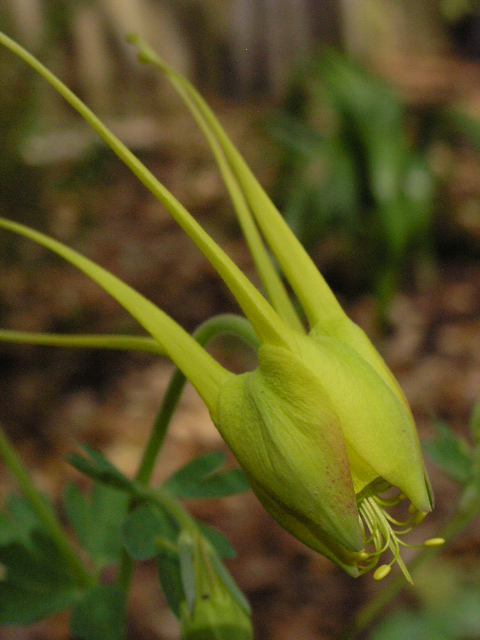
Looking like some brightly-colored horror picture monster, the Texas Gold Columbine (Aquilegia chrysantha var. hinckleyana) has several flowers that have not quite opened.
This will be the first spring for my Mexican Buckeye (Ungnadia speciosa) - so I'm hoping the hint of reddish color on the stems is the beginning of its beautiful bloom cycle.
After being severely trimmed back, the old-fashioned Rose (species unknown) has responded by putting out a lot of growth - most new shoots ending in an unopened flower bud.
Be sure to visit May Dream Gardens to see what is blooming in gardens around the world.
Established Plants
Missouri Violet (Viola missouriensis) has started to produce a few tiny blossoms.
Lenten Rose (Helleborus orientalis) has a few buds, but only one flower has opened.
Pink Shamrock (Oxalis crassipes 'Rosea') has just begun to show a few blooms.
Chocolate Chip Ajuga (Ajuga reptans 'Valfredda') flowers spikes are just beginning to rise, presently most are under a half inch in height.
With only a couple of bloom stalks rising up, the Catlin's Giant Ajuga (Ajuga reptans 'Catlin's Giant') is at its very initial bloom stages.
Reifler's Dwarf Viburnum (Viburnum obovatum 'Reifler Dwarf') only has a couple of florets - I'm hoping more are coming, but I am unable to locate any.
The blooms of the Dwarf Buford Holly (Ilex cornuta 'Burfordii Nana') are inconspicuous (though not to bees!), but hold the promise of red berries for the next winter.
Though damaged by our extreme winter, the surviving Friendship Plants (Billbergia nutans) have produced a few flowers.
New Plants in the Garden
Purchased and planted already in bloom, the Gopher Plant (Euphorbia rigida) shows off its bright yellow colors.
Potted Plants
Pulled out from winter storage, the Ox Tongue (Gasteria liliputana) surprised me by already being in bloom.
The one Ground Orchid (Spathoglottis plicata) that started blooming prior to the winter and was brought inside for protection, has kept its flowers throughout.
Covered in flower buds, the Formosa Red Azalea (Azalea indica 'Formosa Red') only has a couple of blooms presently open - but it holds the promise for quite a show in the not-so-distant future.
Indoor Plants
Almost all of my Moth Orchids (Phalaenopsis sp.) are either in bloom or producing bloom stalks.
Flower Wannabes
Beloved by Mockingbirds, the Mahonia (Mahonia aquifolium) berries are slowly ripening.
Berries of the Nandina (Nandina domestica) seem to last forever, their vibrant red colors brightening the garden.
Almost hidden from view, the black berries of the Liriope (Liriope spicata) shimmer when the sunlight reaches them.
As the leaves of the Possumhaw (Ilex decidua) begin to sprout and grow, its berries are slowly getting hidden away amongst the foliage - though the birds will certainly be hunting them.
Dwarf Chinese Holly (Ilex cornuta 'Rotunda') berries have started to fade, but a few still decorate the spiny leaves.
Tardies
Lady Tulips (Tulipa clusiana) flower buds have begun to rise from the ground, but none of mine have opened.
My Texas Betony (Stachys coccinea) have several flower buds at their branch tips, but none have produced their bright red flowers yet.
The recently added 'Mrs. Pollock' Geranium (Pelargonium x hortorum 'Mrs. Pollock') has yet to open a flower, though a few bloom stalks have risen.
Looking like some brightly-colored horror picture monster, the Texas Gold Columbine (Aquilegia chrysantha var. hinckleyana) has several flowers that have not quite opened.
This will be the first spring for my Mexican Buckeye (Ungnadia speciosa) - so I'm hoping the hint of reddish color on the stems is the beginning of its beautiful bloom cycle.
After being severely trimmed back, the old-fashioned Rose (species unknown) has responded by putting out a lot of growth - most new shoots ending in an unopened flower bud.
Be sure to visit May Dream Gardens to see what is blooming in gardens around the world.
Sunday, October 24, 2010
Stepping Stones
It seems to happen almost every time. I have either a new plant or an existing one in need of a new home. Nothing simpler, right? Get out the garden fork, perhaps a shovel, and simply prepare a spot for it.
And that's when the adventure begins.
On a recent excavation for a transplanted White Margin Snow Rose (Serissa foetida 'Improved'), I quickly hit stone. As usual, this led to the rock bar becoming involved. In this case, I removed a nice triangular limestone flagstone measuring almost 3 foot on the long side.
Thank goodness I got that out of the way. But what's this? Yet another rock. And it appears to be even larger. After some sweating, a second, even larger, stepping stone was produced.
This one measured approximately three foot by three foot.
Well, at least it gives me an additional step (or two) for the path that I've been working on.
Planted in the Ground:
And that's when the adventure begins.
On a recent excavation for a transplanted White Margin Snow Rose (Serissa foetida 'Improved'), I quickly hit stone. As usual, this led to the rock bar becoming involved. In this case, I removed a nice triangular limestone flagstone measuring almost 3 foot on the long side.
Thank goodness I got that out of the way. But what's this? Yet another rock. And it appears to be even larger. After some sweating, a second, even larger, stepping stone was produced.
This one measured approximately three foot by three foot.
Well, at least it gives me an additional step (or two) for the path that I've been working on.
Planted in the Ground:
- Butterfly Iris (Iris 'nada'): The plant was on my investigate list, but when I discovered it on sale, I went ahead bought it. Now I learn that it may want more water than I'm willing to supply. Planted near my pond and time will tell.
- Bella Red Abutilon (Abutilon x hybridum 'Bella Red'): One of my Gotta Get listings; recommended by Central Texas Gardener; I'm a little worried about freeze tolerance.
- Reifler's Dwarf Viburnum (Viburnum obovatum 'Reifler Dwarf'): Decided I had it planted it too close to a path; presently its size was fine, but mature size was going to be too large; so moved further back in the garden. Plus I wanted to make room for the next plant.
- Pale Pavonia (Pavonia hastata): Has been on my Gotta Get list since seeing several area blogs mention it; now I have two. One went into the bed near the pond; the other went into the Viburnum's old location.
- Variegated Mondo Grass (Ophiopogon jaburan 'Vitattus'): Have three that are doing quite well at the base of some trees, but had three others near the pond that seemed to be struggling. Transplanted the struggling ones over next to the happy ones (obviously they like something over there!).
- Milky Way Cast Iron Plant (Aspidistra lurida 'Milky Way'): Transplanted two towards the back of the bed into the locale vacated by the Variegated Mondo Grass.
- Manfreda 'Chocolate Chips' (Manfreda undulata 'Chocolate Chips'): Transplanted from ground to pot; poor fellow has been struggling (being trampled and buried multiple times by some digging critter certainly didn't help it!).
Tuesday, October 19, 2010
Viburnum Munched
Yesterday, I discovered that my Reifler's Dwarf Viburnum (Viburnum obovatum 'Reifler Dwarf') seemed to be losing its leaves. Couldn't quite determine if they had been munched or were falling off. It had been doing quite well and I was looking forward to its fall color and hopefully next years blooms. So I was a wee bit perturbed.
Then, this evening, I checked it again and discovered the culprit:
Or should I say culprits!
I didn't even know that hornworms ate Viburnums. But even though I don't know the variety of these guys, they obviously have a taste for for the plant. Grumble, grumble.
Needless to say, they have now departed the garden.
Planted in the Ground:
Planted in Pots:
Then, this evening, I checked it again and discovered the culprit:
Or should I say culprits!
I didn't even know that hornworms ate Viburnums. But even though I don't know the variety of these guys, they obviously have a taste for for the plant. Grumble, grumble.
Needless to say, they have now departed the garden.
Planted in the Ground:
- Mexican Petunias (Ruellia tweediana 'Colobe Pink'): Added three more to the pond area as they tend to be evergreen in a typical winter
- Gulf Coast Penstemon (Penstemon tenuis): Added three more to the existing small patch to help thicken up the area; hoping this will make for an even better spring showing
- Ghost Plant (Graptopetalum paraguayense): Two more added - one in a dry area near the path and another in the recently created succulent bed (not pictured).
- Lady Tulips 'Cynthia' (Tulipa clusiana 'Cynthia'): Ten more placed into the bed near the pond (not pictured)
Planted in Pots:
- Foxtail Fern (Asparagus densiflorus 'Meyersii'): Have one in the ground; decided to try one in a pot. Not entirely sure if it is winter hardy, but plan on leaving it out (so I guess I'll learn!)
Thursday, February 18, 2010
Reifler's Dwarf Viburnum & Forsythia Sage
Planted Reifler's Dwarf Viburnum (Viburnum obovatum 'Reifler Dwarf') after breaking a hole through the limestone rock layer. Also planted Forsythia Sage (Salvia madrensis). Both planted in backyard at top of path where some dappled sun might penetrate.
Subscribe to:
Posts (Atom)