I previously reported on the protected plants and the results of our prolonged freeze here in central Texas. Now its time to examine the plants that received no protection which showed damage or which looked bad but appear to be recovering.
The Gold Dust Plants (
Aucuba japonica 'Variegata') originally looked quite sad, but after a couple days of warmth, they have completely recovered.
The potted Bear's Breech (
Acanthus 'Summer Beauty') initially looked sad, and now...well...sad doesn't even begin to describe its condition. Will have to see if it recovers from the roots (presently, I am hopeful).
The Formosa Red Azalea (
Azalea indica 'Formosa Red') has also bounced back looking no worse for the exposure. I had though it should be able to handle the conditions, but its droopy look a couple of days ago had me worried.
No surprise here. I had not anticipated the Palm Grass (
Setaria palmifolia) foliage to make it through even our regular winter lows. The plan was for it to return from roots - now I'll just have to wait and see.
The Coral Bells 'Caramel' (
Heuchera villosa 'Caramel') looked a little tired, but is another that bounced back strong once the temperatures warmed up. I had suspected that this plant should be able to handle the lows, but since it is new to my garden, there is always doubt.
Another new plant to the garden is the Butterfly Iris (
Iris 'nada'). It has handled all previous freezes without showing any damage (even putting on some new growth during the warmer spells). But it also was one that looked rather sad - but it has bounced back with only some minor damage.
The forgotten
Gasteraloe 'Midnight' (meant to cover it - though I'm thinking it would not have made a difference) might look healthy in the picture, but every piece of green is soft and mushy. I'm afraid it may be a complete loss.
I have never protected my
Manfreda 'Macho Mocha' (Manfreda x Mangave 'Macho Mocha') (even during last year's 18 degree lows), but they certainly got hurt by the extreme length of this winter's cold exposure. Much of the plant is soft and mushy - can't yet tell if the center is still firm. Time will tell.
The Variegated Flax Lilies (
Dianella tasmanica 'Variegata'), another plant that can handle our typical Central Texas lows, has certainly been knocked back to its roots (much like last year). But it should return.
Blooming just days prior to the serious freeze, the Variegated Abutilons (
Abutilon pictum 'Thompsonii') &
Marilyn's Choice Abutilon all have freeze-dried leaves (and blossoms). As this is my first winter with the Abutilons, I will have to wait and see if they return from the above-ground stems, the roots or even at all.
With day after day of below freezing temperatures, the Texas Gold Columbine (
Aquilegia chrysantha var. hinckleyana) had finally laid flat on the ground. But with warmer temperatures, it has begin to look much healthier.
Two of the garden's three Friendship Plants (
Billbergia nutans) were left to fend for themselves without protection in the cold temperatures. It is really difficult to tell the condition of the plant. It isn't soft or mushy, nor has its color faded or darkened. Will have to give it time to see the effects.
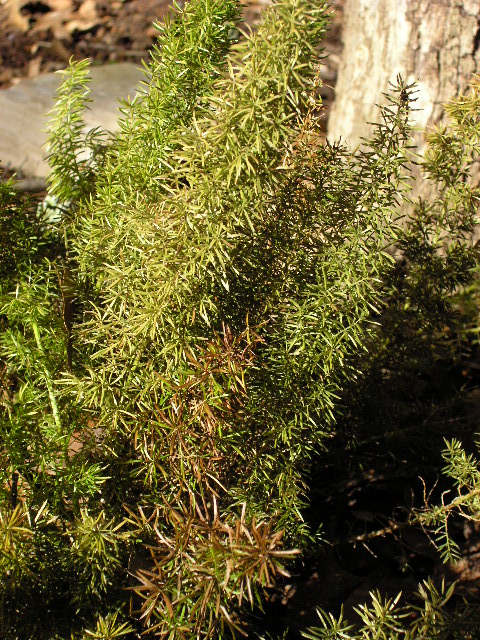
Of the two Foxtail Ferns (
Asparagus densiflorus 'Meyersii'), one is potted and one is in the ground. The protected potted one received minor damage whereas the unprotected soil-based one certainly has more of its stems showing the tell-tale brownish tint that likely will lead to that portion being lost. But the plant should pull through.
Last year's 18 degree low hammered the Lily of the Nile (
Agapanthus africanus) almost completely back to its roots. So this years lengthy freeze (and 17 degree low) will certainly cause a repeat of last year's results.
Also a repeat low temperature victim is the Pink Rain Lilies (
Zephyranthes rosea). Their foliage typically withstand lows in the mid-20s, but temperatures in the teens lead it to lose everything above ground. But spring should see it sprouting once again.
A couple of others that appeared a little upset with the cold, but have survived with only minimal damage include Joe Pye Shrub & Cast Iron Plants (
Aspidistra elatior).
Of course, there are several other plants that did as expected. Evergreens continued on in their foliar ways. Deciduous plants had lost their leaves long ago. The usual perennial culprits disappeared back into the ground, but will return with the spring. Likely, some that presently appear undamaged will begin to show signs as the months progress, and others that looked to have received mortal blows will bounce back.
For now, its a waiting game.