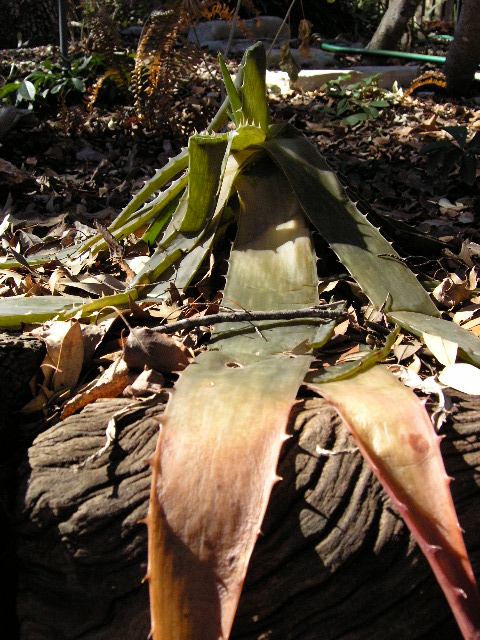
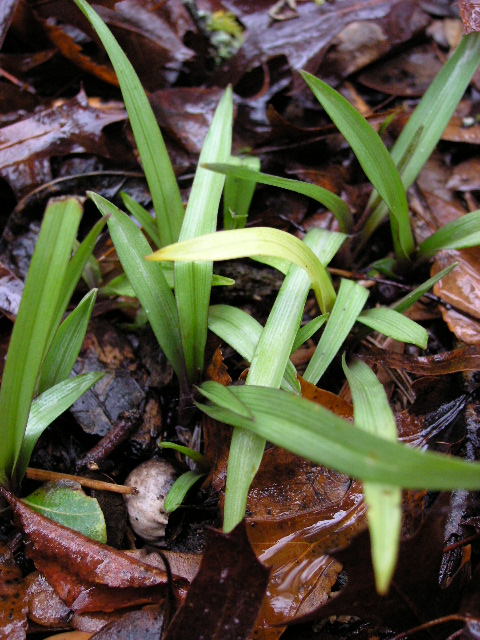
As of today, we have experienced 85 days with a high temperature at or above 100 degrees. The average yearly number of 100 degree days in Austin, Texas is 13.5 - I'm thinking this year will be pushing that average up quite a bit. The previous yearly record for the most 100 degree days was 69 set in 1925 - that record has been absolutely shattered. And to make matters worse, rainfall has been almost non-existent in my garden for most of the year.
Needless to say, participating in Digging's Foliage Follow-up is a bit of struggle.
Be sure to visit Digging to see what foliage can be found in other's gardens. Hope theirs is faring better than mine!
Showing posts with label Foliage Follow-up. Show all posts
Friday, September 16, 2011
Saturday, July 16, 2011
Foliage Follow-up: July 2011
Flowers are great, but the majority of the plant is its foliage - so Digging invites us to celebrate this by posting some pictures of the leaves that make up most of our gardens' show. I decided to concentrate on a few of the plants that seem to be handling our extreme drought and heat better than the rest of my tired, dry collection. All but one are planted in pots - so maybe that is making the difference.
Originally planted in the ground where it struggled, the Star Begonia (Begonia heracleifolia) produced a nice set of blooms this spring and then, as the temperatures increased, it really started putting out the leaves. It has grown four times bigger than it has ever managed before. It's large palmate leaves and hairy stems are quite unique.
Quickly becoming my favorite Aloe, the Lace Aloe (Aloe aristata) has continued to look good and slowly add additional size. Though it has never bloomed, its foliage is extremely attractive and quite different than any of my other Aloes.
Another Aloe that is doing well is the Vuurpylaalwyn (Aloe peglerae) - gotta love a name like that! Almost appearing Agave-like, its leaves have thorns along both its sides and even the underside edge. Appearing quite fearsome, it has been doing well in the heat with only occasional splashes of water.
The only highlighted specimen actually planted in the ground, the Dyckia 'Cherry Coke' has to compete with the trees and other plants for moisture. But it is doing great (and was the only Dyckia to make it through last winter's extreme cold snap with little to no damage). Starting the year off with a green cast, increased sunshine and temperature has caused it to develop a nice reddish hue.
Be sure to visit Digging to see the foliage that is stealing the show in other gardens.
Thursday, June 16, 2011
Foliage Follow-up: June 2011
As a follow-up to Garden Blogger's Bloom Day, Digging allows us the chance to show off the leafy aspects of our gardens. With our ongoing drought, plants start the morning looking somewhat perky, and end the day looking pretty wilted.
One potted plant in my garden that demands a bit more water is this pass-along Coleus from Robin at Getting Grounded. I was able to over-winter the plant and it is now back to its former glory. I love the combination of green and maroon splashed about throughout its foliage.
The colors blend together and no two leafs show the same pattern. Though green and maroon are the primary colors, their combination leads to additional flavors of pink and beige.
As the sun sets, it peeks through the upper canopy and highlights the Coleus from behind, lighting up the maroon undersides of the upturned leaves.
I'm unsure as to the variety name of the plant, but it has certainly been a star performer in my garden.
Be sure to visit the Digging blog to see the foliar shows found in other gardens.
Saturday, April 16, 2011
Foliage Follow-up: April 2011
On the sixteenth of every month, Digging invites us to join her in celebrating the leafy aspects of our garden by participating in Foliage Follow-up. With temperatures soaring, central Texas plants have certainly shaken off winter's doldrums and growth is happening everywhere.
I thought I'd highlight one of the more rampant foliar aspects of my garden - a groundcover that can be found in almost every one of my beds. It is a native plant that initially appears as a few widely spaced plants, sprouting here and there.
But its amazing trait is that if simply ignored, it will quickly produce a thick verdant cover completely crowding out all your other garden plants. Though squirrels have been known to bury the occasional seed, these individual plants are nothing compared to the creeping wonder that readily sprouts from the roots of the adult plant.
Unfortunately, to produce truly amazing beds of this plant, they must develop naturally from the roots of the much larger adult plant. You can plant an adult specimen, but will likely have to wait for decades to get the full benefit of its ground cover.
Yes, I'm describing the wondrous Live Oak (Quercus virginiana). The adult trees naturally shade out almost all other plants, and quickly suck moisture from the soil, thereby depriving it from other more tender plants. This "bare" area, of course, cries out to the gardener to fill it with exotic and beautiful plants - never understanding that if they are just patient (or even if they are not), soon root sprouts will appear.
And if the gardener is distracted for a few moments, they will explode into luxuriant growth and quickly bury all those costly and lovingly tended plants - quickly making them obsolete.
Sigh...where are my pruners? Looks like a long day of snipping.
Wednesday, March 16, 2011
Foliage Follow-up: March 2011
Digging hosts Foliage Follow-up on the sixteenth of every month so that the foliar aspects of our garden have their chance to shine. For this posting, I decided to concentrate on some of the more recent additions to my garden.
Planted last fall, this will be the first spring for the Oakleaf Hydrangea 'Alice' (Hydrangea quercifolia 'Alice'). It never completely lost all of its leaves, but is certainly putting out plenty of new growth.
Crimson Queen Japanese Maple (Acer palmatum var. dissectum 'Crimson Queen') is the first Maple I have ever tried planting directly into the ground. Its unfolding red leaves are very nice; I hope it establishes itself.
When purchased, this Manfreda didn't have a species name. It died back completely in winter, but is now emerging with nicely spotted foliage. Suspect it might be a Rattlesnake Agave (Manfreda maculosa), but I think it may grow a little larger than is the norm for that variety (if anyone can identify, please let me know).
The foliage of the Coral Bells 'Caramel' (Heuchera villosa 'Caramel') has a wide range of shades - from green to red. The new growth has the redder colors whereas the older leaves stay green. Very impressive coloration.
Have always enjoyed the strongly-patterned initial leaf coloration of the Lyreleaf Sage (Salvia lyrata). It eventually tends to fade back towards a solid green, but that first production of leaves is very nice.
With a diminutive bloom at its center, the Red Billbergia's (Billbergia sp. 'Red') foliage is the primary reason to add it to one's garden.
Be sure to visit Digging to see other Foliage Follow-up postings.
Wednesday, February 16, 2011
Foliage Follow-up: February 2011
The sixteenth of every month gives us the chance, through the Digging blog, to show off the leafy aspects of our gardens by participating in Foliage Follow-up. After 60+ straight hours of below freezing temperatures (extremely unusual for central Texas), my foliage is feeling the pain.
The Cyclamen (Cyclamen persicum) couldn't stand up to the extended cold. All of them are cold-burnt husks of their former selves.
The leaves of the Dwarf Barbados Cherry (Malphigia glabra) suffered during last winter's 18 degree lows; so it didn't fare any better during this winter's 17 degree low.
Where once the leaves of my several Lily of the Nile (Agapanthus africanus) created green waves, I now have a flattened mass of pale yellow.
Initially looking as if it had only suffered minor damage, the unprotected Foxtail Fern (Asparagus densiflorus 'Meyersii') has turned a rather lovely tan shade. Though I certainly hope it returns from its roots to its former green glory, I'm presently enjoying its brownish cast.
Of course, one of the harder hit plants was the Soap Aloe (Aloe maculata). Though it looks like at least a few have hardy pups, the large specimens have all begun to melt away from exposure to the severe cold.
Long ago, I actually planted some Australian Sword Fern (Nephrolepis obliterata 'Kimberly Queen') out in the ground. Inevitably, it always gets knocked back to the ground but returns the next spring, putting out a few scattered fronds here and there. Then winter returns and once again turns its fronds a brownish hue.
But not all is decaying. Amongst the leaf litter I discovered some sprouts from the Spanish Bluebells (Hyacinthoides hispanica). They had originally been planted into a pot, where all they did was produce foliage. I took them out of the pot and hung on to them over the summer and eventually put them into the ground - believing they were likely no longer viable. But some of them are coming up!
And the first of my Lady Tulips (Tulipa clusiana) has broken ground, just beginning its growth up towards the sunshine. This will be its second spring in my garden, so I'm very interested to see if they bloom as well as they did last year.
Be sure to visit Digging to see what leafy delights can be found in other gardens.
Sunday, January 16, 2011
Foliage Follow-up: January 2011
Foliage Follow-up is sponsored by the Digging garden blog on the sixteenth of every month, where we get to celebrate the leafy aspects of our gardens. On this dreary, drippy day, I decided to concentrate on the few plants I have that tend to disappear in our summer's heat but make a return in the coolness of winter.
Though only starting to peak out from the leaf litter, the Sweet Kate Spiderwort (Tradescantia x andersoniana 'Sweet Kate') has begun to produce some green amongst the brown. It will primarily shine during the spring, but will fade once things get hot and dry.
Considered by many to be invasive, I threw caution to the wind this past spring and added White Shamrock (Oxalis crassipes 'Alba') to my garden. It completely disappeared in the summer, but has been coming back strong this winter.
Back in mid-September, from the bare ground, up shot my first Red Spider Lily (Lycoris radiata) bloom. I'm hoping for plenty more blossoms next fall as the bulbs are producing good foliage this winter.
After almost completely disappearing over the summer, Bear's Breech (Acanthus 'Summer Beauty') always comes on strong once the temperatures start dropping. Its huge leaves make an impressive show (though recent low temperatures have wilted the plant a little).
Another plant that is completely lacking vegetation in the summer, the Oxblood Lily (Rhodophiala bifida) is once again making its presence known. Planted only last March, I have yet to get any blooms but hope some will make an appearance this fall.
Wasn't sure if my spring-planted Heartleaf Skullcap (Scutellaria ovata) had made it through the summer heat. Winter and early spring should be its time to shine, but I'm not completely confident with it yet.
Though present year-round, the Burgundy Glow Ajuga (Ajuga reptans 'Burgundy Glow') does add quite a bit to the winter color. The burgundy coloration intensifies and spreads during the colder temperatures and makes it quite eye-catching.
Be sure to visit Digging to see the foliage that other gardeners are sharing from their winter gardens.
Thursday, December 16, 2010
Foliage Follow-up: December 2010
On the sixteenth of each month, Digging sponsors the Foliage Follow-up to allow gardeners to show off the leafy aspects of their garden. Freezing temperatures have only given my garden the briefest of kisses, thus much of my "fall" foliage is just now starting to show some color.
The high canopy of my trees tends to require one to tilt one's head back far to appreciate any fall color. But when the sunlight catches the yellow leaves of the Black Cherry Tree, it is certainly worth the effort.
And the leaves of the Red Oak against a clear blue sky make a captivating sight.
In the understory, the lower shrubs try to add some small patches of fall color. The leaves of the Chinese Indigo (Indigofera kirilowii) are fading to yellow.
As are those of the Goldmound Spirea (Spiraea japonica 'Goldmound') showing a very nice mixture of green and gold.
Philippine Violets (Barleria cristata) lower leaves are beginning to add a burgundy touch to the garden.
And the newly acquired Mexican Buckeye (Ungnadia speciosa) will hopefully grow taller and fill in as an understory tree, and provide an even larger swath of fall color.
Be sure to visit other Foliage Follow-up postings at Digging to see more of other garden's leafy sites.
Subscribe to:
Posts (Atom)