Since planting my Leopard Plant (Ligularia tussilaginea 'Aureo-maculata') a couple of years ago, it has diminished each spring. So I finally decided to dig it up and eventually find it a new location.
In its place, I moved my three Sparkler Sedges (Carex phyllocephala 'Sparkler') which have been doing alright, but certainly not flourishing. Hopefully, they'll be happier in the new spot.
Showing posts with label Carex. Show all posts
Sunday, February 8, 2015
Sunday, May 15, 2011
Flower Power: GBBD May 2011
On the fifteenth of every month, May Dream Gardens invites us to share the plants that are blooming in our gardens. Between the drought and high spring temperatures, many of my plants are either no longer blooming or are in the final stages.
Established Plants
A recent rain shower (thank goodness!) inspired the Pink Rain Lilies (Zephyranthes rosea) to produce a few blooms in celebration. The first wave is fading, but others are still on the way.
In last stages of its bloom period, the Dwarf Gardenia (Gardenia jasminoides 'Radicans') still has a couple of its fragrant blossoms open. They tend not to last long outside, as they get snipped and brought inside so we can enjoy their perfume.
Likely to continue going strong all summer, the pond plant Aztec Arrowhead (Sagittaria montevidensis) is already on its second bloom stalk.
Fading in the heat, I'm hoping that a good shearing will help the Anthony Waterer Spirea (Spiraea x bumalda 'Anthony Waterer') to produce another wave of the magenta flower clusters.
Moved deeper into the shade, the Red Dragon Knoweed (Persicaria microcephala 'Red Dragon') seems to be quite happy. Time will tell as summer's heat has, in the past, made it look quite tired. I'm hoping the increased shade will help it out during those times.
Rock Rose (Pavonia lasiopetala), of course, can always be counted on to put on a show with its intensely pink blooms. It tends to get lanky in my shade, so I must remember to shear them back on occasion.
Some of the initial flowers of the West Texas Mist Flower (Conoclinium greggii) are looking tired, but this is just the first crest of a summer long purple wave.
They don't last long, but the blooms of the Crinum (species unknown) are quite eye-catching when at their peak. Already fading, it will sometimes produce a second wave of bloom stalks (here's hoping).
New Plants in the Garden
I am very pleased with the Oakleaf Hydrangea 'Alice' (Hydrangea quercifolia 'Alice') in its first spring in the shade. Though it only produced two clusters of long lasting flowers, it has almost doubled in size - so next years show looks quite promising.
This is as close to a "flower" as Sparkler Sedge (Carex phyllocephala 'Sparkler') will ever get, but it was fun to discover the inflorescence while looking about the garden.
Potted Plants
Though starting to fade, the flowers of the Orange Kaffir Lily (Clivia miniata) are still showing intense color that catches the eye.
The only rose that has at least survived in my shady garden, I have never known the exact name of this Old-fashioned Rose. It produces a few small blooms throughout the summer.
A pass-along from Robin (Getting Grounded) that I over-wintered inside, the Bleeding Heart Vine (Clerodendrum thomsoniae) has not grown much yet. But it has still been able to produce a small group of blooms.
Indoor Plants
Still going strong, the flowers of the Moth Orchids (Phalaenopsis sp.) just seem to last forever. The first couple of pictures are from plants that are just now opening their flower buds. But the others have been putting on a show for over a month.
Tardies
Hit hard by this winter's extremes, only a single flower stalk is rising from the recovering Lily of the Nile (Agapanthus africanus).
Also recovering from the lengthy winter freezes, the Amaryllis 'San Antonio Rose' (Hippeastrum 'San Antonio Rose') are nonetheless producing several flower stalks. Soon the red blooms will add color to this area of the garden.
Be sure to visit May Dream Gardens to see what is blooming in other gardens.
Planted in the Ground:
Established Plants
A recent rain shower (thank goodness!) inspired the Pink Rain Lilies (Zephyranthes rosea) to produce a few blooms in celebration. The first wave is fading, but others are still on the way.
In last stages of its bloom period, the Dwarf Gardenia (Gardenia jasminoides 'Radicans') still has a couple of its fragrant blossoms open. They tend not to last long outside, as they get snipped and brought inside so we can enjoy their perfume.
Likely to continue going strong all summer, the pond plant Aztec Arrowhead (Sagittaria montevidensis) is already on its second bloom stalk.
Fading in the heat, I'm hoping that a good shearing will help the Anthony Waterer Spirea (Spiraea x bumalda 'Anthony Waterer') to produce another wave of the magenta flower clusters.
Moved deeper into the shade, the Red Dragon Knoweed (Persicaria microcephala 'Red Dragon') seems to be quite happy. Time will tell as summer's heat has, in the past, made it look quite tired. I'm hoping the increased shade will help it out during those times.
Rock Rose (Pavonia lasiopetala), of course, can always be counted on to put on a show with its intensely pink blooms. It tends to get lanky in my shade, so I must remember to shear them back on occasion.
Some of the initial flowers of the West Texas Mist Flower (Conoclinium greggii) are looking tired, but this is just the first crest of a summer long purple wave.
They don't last long, but the blooms of the Crinum (species unknown) are quite eye-catching when at their peak. Already fading, it will sometimes produce a second wave of bloom stalks (here's hoping).
New Plants in the Garden
I am very pleased with the Oakleaf Hydrangea 'Alice' (Hydrangea quercifolia 'Alice') in its first spring in the shade. Though it only produced two clusters of long lasting flowers, it has almost doubled in size - so next years show looks quite promising.
This is as close to a "flower" as Sparkler Sedge (Carex phyllocephala 'Sparkler') will ever get, but it was fun to discover the inflorescence while looking about the garden.
Potted Plants
Though starting to fade, the flowers of the Orange Kaffir Lily (Clivia miniata) are still showing intense color that catches the eye.
The only rose that has at least survived in my shady garden, I have never known the exact name of this Old-fashioned Rose. It produces a few small blooms throughout the summer.
A pass-along from Robin (Getting Grounded) that I over-wintered inside, the Bleeding Heart Vine (Clerodendrum thomsoniae) has not grown much yet. But it has still been able to produce a small group of blooms.
Indoor Plants
Still going strong, the flowers of the Moth Orchids (Phalaenopsis sp.) just seem to last forever. The first couple of pictures are from plants that are just now opening their flower buds. But the others have been putting on a show for over a month.
Tardies
Hit hard by this winter's extremes, only a single flower stalk is rising from the recovering Lily of the Nile (Agapanthus africanus).
Also recovering from the lengthy winter freezes, the Amaryllis 'San Antonio Rose' (Hippeastrum 'San Antonio Rose') are nonetheless producing several flower stalks. Soon the red blooms will add color to this area of the garden.
Be sure to visit May Dream Gardens to see what is blooming in other gardens.
Planted in the Ground:
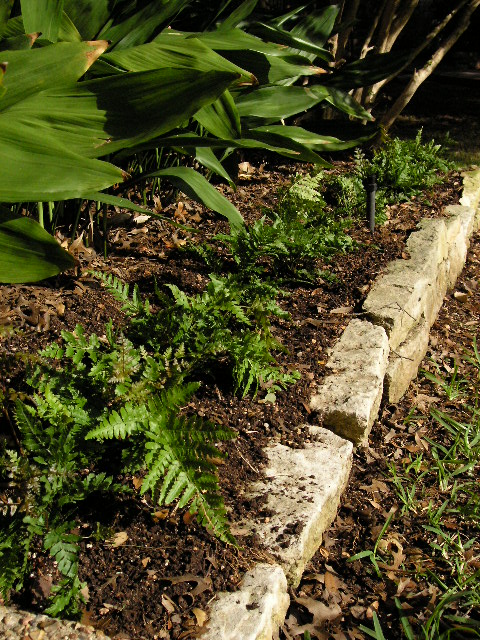
- Autumn Fern (Dryopteris erythrosora): Already had several on the left side of my front beds; finally got around to adding thirteen to the right side.
Monday, February 21, 2011
We Have Discovered Life
One thing about viewing the cold-crisped, brown landscape from my window, one only sees the wider view. But with time and warmer weather permitting, I've been able to get out in the garden and start trimming away some of the winter damage. And this closer view allowed for the discovery of new green growth.
Spanish Bluebells (Hyacinthoides hispanica) have been popping out the ground and growing fast. Hope they set some blooms this year.
Lady Tulips (Tulipa clusiana) did well last year and this year the number of sprouts has increased (I really like their blue-green color). Hope I have even more of their lovely flowers,
Toad Lily (Tricyrtis lasiocarpa) have begun to emerge. The potted one has added over a foot of growth already, but the ground-bound plants are just now emerging.
Missouri Violet (Viola missouriensis) got seriously beat up by tree trimmers and their subsequent brush removal. But new tiny leaves are appearing.
Texas Gold Columbine (Aquilegia chrysantha var. hinckleyana) came through the long freeze fairly well, and now its even putting out plenty of new leaves.
Southern Wood Fern (Dryopteris normalis) is relatively new to my garden. As expected, the fronds got freeze-dried. But tiny (only about a quarter inch) fiddleheads are sprouting from the leaf litter.
Sparkler Sedge (Carex phyllocephala 'Sparkler') is another plant that handled the winter quite well. It too is already putting out new growth.
Even though in a fairly shady area, the Anthony Waterer Spirea (Spiraea x bumalda 'Anthony Waterer') is already putting out new leaves. Just three feet away and receiving more sunlight, the Goldmound Spirea (Spiraea japonica 'Goldmound') has yet to make a showing.
Though the entire pond was covered with a sheet of ice for several days, it didn't take the Aztec Arrowhead (Sagittaria montevidensis) long to send up its first leaf.
Several of my scattered Amaryllis (Hippeastrum sp.) have already sprouted the beginnings of their strap-like foliage.
Two of the three Friendship Plants (Billbergia nutans) were left uncovered and may be a loss. But one, due to its location near some Aloes, got some cover. Though also damaged, it is rewarding this extra attention by already starting to produce some bloom stalks.
Though still early, hints of spring are certainly in the air...and in the plants.
Spanish Bluebells (Hyacinthoides hispanica) have been popping out the ground and growing fast. Hope they set some blooms this year.
Lady Tulips (Tulipa clusiana) did well last year and this year the number of sprouts has increased (I really like their blue-green color). Hope I have even more of their lovely flowers,
Toad Lily (Tricyrtis lasiocarpa) have begun to emerge. The potted one has added over a foot of growth already, but the ground-bound plants are just now emerging.
Missouri Violet (Viola missouriensis) got seriously beat up by tree trimmers and their subsequent brush removal. But new tiny leaves are appearing.
Texas Gold Columbine (Aquilegia chrysantha var. hinckleyana) came through the long freeze fairly well, and now its even putting out plenty of new leaves.
Southern Wood Fern (Dryopteris normalis) is relatively new to my garden. As expected, the fronds got freeze-dried. But tiny (only about a quarter inch) fiddleheads are sprouting from the leaf litter.
Sparkler Sedge (Carex phyllocephala 'Sparkler') is another plant that handled the winter quite well. It too is already putting out new growth.
Even though in a fairly shady area, the Anthony Waterer Spirea (Spiraea x bumalda 'Anthony Waterer') is already putting out new leaves. Just three feet away and receiving more sunlight, the Goldmound Spirea (Spiraea japonica 'Goldmound') has yet to make a showing.
Though the entire pond was covered with a sheet of ice for several days, it didn't take the Aztec Arrowhead (Sagittaria montevidensis) long to send up its first leaf.
Several of my scattered Amaryllis (Hippeastrum sp.) have already sprouted the beginnings of their strap-like foliage.
Two of the three Friendship Plants (Billbergia nutans) were left uncovered and may be a loss. But one, due to its location near some Aloes, got some cover. Though also damaged, it is rewarding this extra attention by already starting to produce some bloom stalks.
Though still early, hints of spring are certainly in the air...and in the plants.
Tuesday, February 15, 2011
Flower Power: GBBD February 2011
On the fifteenth of every month, May Dream Gardens gives us the opportunity to share the plants that are blooming in our gardens. February looks to be a very bleak month for my shady garden. None of my ground-bound plants are actually in bloom, but color can be found in the berries and the protected potted specimens.
Potted Plants
The three Ground Orchids (Spathoglottis plicata) that were planted in the ground are now brown, crispy critters. But the one I potted and kept indoors has been in bloom for over a month. Many of the blossoms have faded, but there are still some unopened buds.
Not sure if one can really call it a flower, but this is as close as Cherokee Sedge (Carex cherokeensis) is likely ever going to get.
Indoor Plants
The only indoor plants I've ever had consistently bloom are the hybrids of the Moth Orchids (Phalaenopsis sp.). One of the orchids we have had for quite a while is producing a bloom stalk, but has not yet developed it's flower buds. So I'm cheating a little bit by showing three recent purchases that were already in full bloom when bought.
Flower Wannabes
Though my ground-bound plants are lacking in blooms, they are making up for it with their bright red fruit. One of the consistent performers is the Nandina (Nandina domestica) which are thick with clusters of bright red berries.
Small clusters of the berries decorate the glossy leaves of the Dwarf Buford Holly (Ilex cornuta 'Burfordii Nana'), though I seem to have fewer on the plant this year than in seasons past.
The prickly leaves of the Dwarf Chinese Holly (Ilex cornuta 'Rotunda') sometimes hide its small groups of red berries. Though never thickly adorned, I have had more than usual this year (likely due to more sunshine reaching the plants since a tree fell and opened the canopy).
Another whose berry production can vary widely, the Possumhaw (Ilex decidua) can still catch the eye even with just a few of its bright red orbs.
Be sure to visit May Dream Gardens to see what is flowering in other gardens.
Potted Plants
The three Ground Orchids (Spathoglottis plicata) that were planted in the ground are now brown, crispy critters. But the one I potted and kept indoors has been in bloom for over a month. Many of the blossoms have faded, but there are still some unopened buds.
Not sure if one can really call it a flower, but this is as close as Cherokee Sedge (Carex cherokeensis) is likely ever going to get.
Indoor Plants
The only indoor plants I've ever had consistently bloom are the hybrids of the Moth Orchids (Phalaenopsis sp.). One of the orchids we have had for quite a while is producing a bloom stalk, but has not yet developed it's flower buds. So I'm cheating a little bit by showing three recent purchases that were already in full bloom when bought.
Flower Wannabes
Though my ground-bound plants are lacking in blooms, they are making up for it with their bright red fruit. One of the consistent performers is the Nandina (Nandina domestica) which are thick with clusters of bright red berries.
Small clusters of the berries decorate the glossy leaves of the Dwarf Buford Holly (Ilex cornuta 'Burfordii Nana'), though I seem to have fewer on the plant this year than in seasons past.
The prickly leaves of the Dwarf Chinese Holly (Ilex cornuta 'Rotunda') sometimes hide its small groups of red berries. Though never thickly adorned, I have had more than usual this year (likely due to more sunshine reaching the plants since a tree fell and opened the canopy).
Another whose berry production can vary widely, the Possumhaw (Ilex decidua) can still catch the eye even with just a few of its bright red orbs.
Be sure to visit May Dream Gardens to see what is flowering in other gardens.
Sunday, February 6, 2011
Uncovering The Plants
Unwrapping the plants from their protective (ha!) covers is a bit like an evil birthday party where many of the gifts are pleasant surprises, but a few are twisted, melting, blackened carcasses. Ooo, what fun - let's open the next one.
For this posting, I'll examine the plants which were left outside but received some form of protection. (Will examine those left to fend for themselves on a subsequent posting.)
The Foxtail Fern (Asparagus densiflorus 'Meyersii') showed some minor damage, but actually came through in good shape (especially for a recently potted plant).
The two Sago Palms came through beautifully. Of course, not only did they receive a cover, but a spotlight was placed underneath each one to give some additional warmth. The light bulb trick made a huge difference.
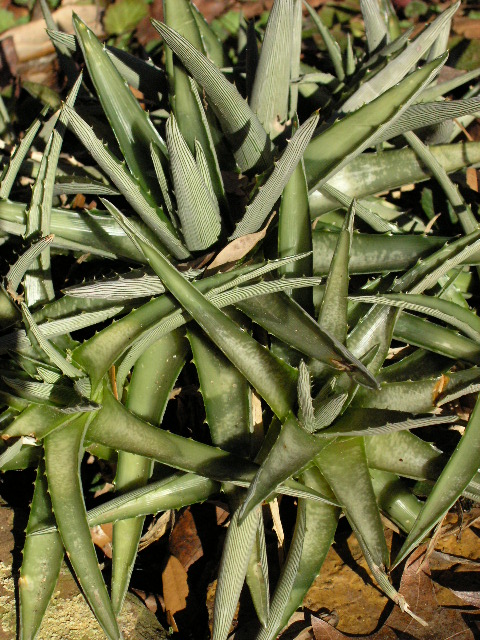
The Dyckias are all looking a little sad - a combination of cold and cover weight. Some of the spiky leaves seem a little more pliable than normal. Will have to wait to see how well they recover, but I'm at least hopeful.
The Soap Aloes (Aloe saponaria) got hammered. For that length of cold, covers made no difference. They likely would have benefited from the addition of a light source for warmth, but that would be difficult as they are widely scattered around the yard.
But at least some of the pups appear to be firm and strong, so there is a chance some will survive and grow from these.
The Aloe 'Hedgehog' (Aloe humilis 'Hedgehog') also got hit hard. Though it appears that some portions of the plant will likely survive, it will be significantly reduced. In the future, my succulent bed may get its own spotlight.
In the covered succulent bed along with some of the Aloes and Dyckias, this Manfreda looks rather sad. Species unknown, it has seemed less hardy as the 'Macho Mocha' - but the seller at the Austin Cactus & Succulent show said it would likely die back to the ground, but would return.
The Pittosporum Creme De Mint (Pittosporum tobira 'Shima') will, in the future, likely not even get covered. It only received special treatment this winter since it was a recent transplant. Though somehwat flattened, it appears to be in a good shape.
Much like the Pittosprum, the Sparkler Sedge (Carex phyllocephala 'Sparkler') primarily got protection due to their recent planting. All of them came through with little or no damage.
The vast majority of my plants are typically left to fend for themselves. In the near future, I will try to post a listing of those that show damage and those that looked bad but recovered.
For this posting, I'll examine the plants which were left outside but received some form of protection. (Will examine those left to fend for themselves on a subsequent posting.)
The Foxtail Fern (Asparagus densiflorus 'Meyersii') showed some minor damage, but actually came through in good shape (especially for a recently potted plant).
The two Sago Palms came through beautifully. Of course, not only did they receive a cover, but a spotlight was placed underneath each one to give some additional warmth. The light bulb trick made a huge difference.
The Dyckias are all looking a little sad - a combination of cold and cover weight. Some of the spiky leaves seem a little more pliable than normal. Will have to wait to see how well they recover, but I'm at least hopeful.
| Dyckia 'Cherry Coke' |
| Red-leafed Dyckia (Dyckia 'Red Devil') |
| Pineapple Dyckia (Dyckia brevifolia) |
| Bronze Dyckia (Dyckia fosteriana 'Bronze') |
| Dyckia platyphylla |
The Soap Aloes (Aloe saponaria) got hammered. For that length of cold, covers made no difference. They likely would have benefited from the addition of a light source for warmth, but that would be difficult as they are widely scattered around the yard.
But at least some of the pups appear to be firm and strong, so there is a chance some will survive and grow from these.
The Aloe 'Hedgehog' (Aloe humilis 'Hedgehog') also got hit hard. Though it appears that some portions of the plant will likely survive, it will be significantly reduced. In the future, my succulent bed may get its own spotlight.
In the covered succulent bed along with some of the Aloes and Dyckias, this Manfreda looks rather sad. Species unknown, it has seemed less hardy as the 'Macho Mocha' - but the seller at the Austin Cactus & Succulent show said it would likely die back to the ground, but would return.
The Pittosporum Creme De Mint (Pittosporum tobira 'Shima') will, in the future, likely not even get covered. It only received special treatment this winter since it was a recent transplant. Though somehwat flattened, it appears to be in a good shape.
Much like the Pittosprum, the Sparkler Sedge (Carex phyllocephala 'Sparkler') primarily got protection due to their recent planting. All of them came through with little or no damage.
The following seemed to have survived with varying degrees of damage:
- Anthony Waterer Spirea (Spiraea x bumalda 'Anthony Waterer')
- Amaryllis 'San Antonio Rose' (Hippeastrum 'San Antonio Rose')
- Bella Red Abutilon (Abutilon x hybridum 'Bella Red')
- Wood Betony (Stachys officinalis)
- Friendship Plants (Billbergia nutans) (though hard to tell)
The vast majority of my plants are typically left to fend for themselves. In the near future, I will try to post a listing of those that show damage and those that looked bad but recovered.
Subscribe to:
Posts (Atom)