The sixteenth of every month gives us the chance, through the Digging blog, to show off the leafy aspects of our gardens by participating in Foliage Follow-up. After 60+ straight hours of below freezing temperatures (extremely unusual for central Texas), my foliage is feeling the pain.
The Cyclamen (Cyclamen persicum) couldn't stand up to the extended cold. All of them are cold-burnt husks of their former selves.
The leaves of the Dwarf Barbados Cherry (Malphigia glabra) suffered during last winter's 18 degree lows; so it didn't fare any better during this winter's 17 degree low.
Where once the leaves of my several Lily of the Nile (Agapanthus africanus) created green waves, I now have a flattened mass of pale yellow.
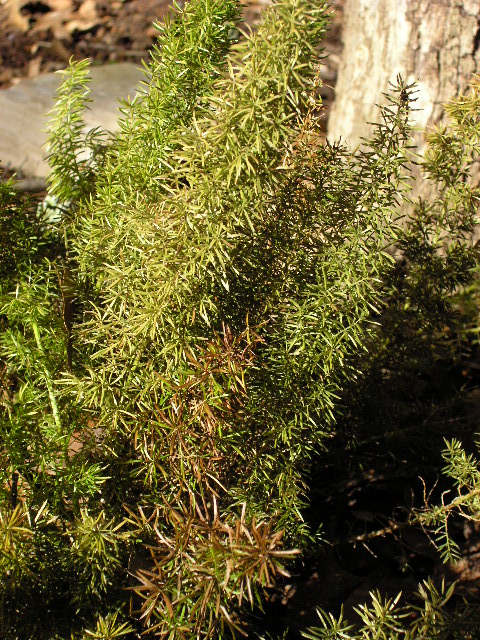
Initially looking as if it had only suffered minor damage, the unprotected Foxtail Fern (Asparagus densiflorus 'Meyersii') has turned a rather lovely tan shade. Though I certainly hope it returns from its roots to its former green glory, I'm presently enjoying its brownish cast.
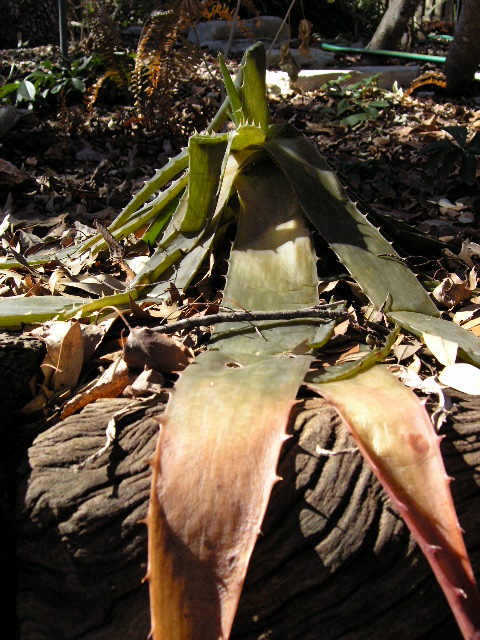
Of course, one of the harder hit plants was the Soap Aloe (Aloe maculata). Though it looks like at least a few have hardy pups, the large specimens have all begun to melt away from exposure to the severe cold.
Long ago, I actually planted some Australian Sword Fern (Nephrolepis obliterata 'Kimberly Queen') out in the ground. Inevitably, it always gets knocked back to the ground but returns the next spring, putting out a few scattered fronds here and there. Then winter returns and once again turns its fronds a brownish hue.
But not all is decaying. Amongst the leaf litter I discovered some sprouts from the Spanish Bluebells (Hyacinthoides hispanica). They had originally been planted into a pot, where all they did was produce foliage. I took them out of the pot and hung on to them over the summer and eventually put them into the ground - believing they were likely no longer viable. But some of them are coming up!
And the first of my Lady Tulips (Tulipa clusiana) has broken ground, just beginning its growth up towards the sunshine. This will be its second spring in my garden, so I'm very interested to see if they bloom as well as they did last year.
Be sure to visit Digging to see what leafy delights can be found in other gardens.
Showing posts with label Asparagus. Show all posts
Wednesday, February 16, 2011
Monday, February 7, 2011
Unprotected Results
I previously reported on the protected plants and the results of our prolonged freeze here in central Texas. Now its time to examine the plants that received no protection which showed damage or which looked bad but appear to be recovering.
The Gold Dust Plants (Aucuba japonica 'Variegata') originally looked quite sad, but after a couple days of warmth, they have completely recovered.
The potted Bear's Breech (Acanthus 'Summer Beauty') initially looked sad, and now...well...sad doesn't even begin to describe its condition. Will have to see if it recovers from the roots (presently, I am hopeful).
The Formosa Red Azalea (Azalea indica 'Formosa Red') has also bounced back looking no worse for the exposure. I had though it should be able to handle the conditions, but its droopy look a couple of days ago had me worried.
No surprise here. I had not anticipated the Palm Grass (Setaria palmifolia) foliage to make it through even our regular winter lows. The plan was for it to return from roots - now I'll just have to wait and see.
The Coral Bells 'Caramel' (Heuchera villosa 'Caramel') looked a little tired, but is another that bounced back strong once the temperatures warmed up. I had suspected that this plant should be able to handle the lows, but since it is new to my garden, there is always doubt.
Another new plant to the garden is the Butterfly Iris (Iris 'nada'). It has handled all previous freezes without showing any damage (even putting on some new growth during the warmer spells). But it also was one that looked rather sad - but it has bounced back with only some minor damage.
The forgotten Gasteraloe 'Midnight' (meant to cover it - though I'm thinking it would not have made a difference) might look healthy in the picture, but every piece of green is soft and mushy. I'm afraid it may be a complete loss.
I have never protected my Manfreda 'Macho Mocha' (Manfreda x Mangave 'Macho Mocha') (even during last year's 18 degree lows), but they certainly got hurt by the extreme length of this winter's cold exposure. Much of the plant is soft and mushy - can't yet tell if the center is still firm. Time will tell.
The Variegated Flax Lilies (Dianella tasmanica 'Variegata'), another plant that can handle our typical Central Texas lows, has certainly been knocked back to its roots (much like last year). But it should return.
Blooming just days prior to the serious freeze, the Variegated Abutilons (Abutilon pictum 'Thompsonii') & Marilyn's Choice Abutilon all have freeze-dried leaves (and blossoms). As this is my first winter with the Abutilons, I will have to wait and see if they return from the above-ground stems, the roots or even at all.
With day after day of below freezing temperatures, the Texas Gold Columbine (Aquilegia chrysantha var. hinckleyana) had finally laid flat on the ground. But with warmer temperatures, it has begin to look much healthier.
Two of the garden's three Friendship Plants (Billbergia nutans) were left to fend for themselves without protection in the cold temperatures. It is really difficult to tell the condition of the plant. It isn't soft or mushy, nor has its color faded or darkened. Will have to give it time to see the effects.
Of the two Foxtail Ferns (Asparagus densiflorus 'Meyersii'), one is potted and one is in the ground. The protected potted one received minor damage whereas the unprotected soil-based one certainly has more of its stems showing the tell-tale brownish tint that likely will lead to that portion being lost. But the plant should pull through.
Last year's 18 degree low hammered the Lily of the Nile (Agapanthus africanus) almost completely back to its roots. So this years lengthy freeze (and 17 degree low) will certainly cause a repeat of last year's results.
Also a repeat low temperature victim is the Pink Rain Lilies (Zephyranthes rosea). Their foliage typically withstand lows in the mid-20s, but temperatures in the teens lead it to lose everything above ground. But spring should see it sprouting once again.
A couple of others that appeared a little upset with the cold, but have survived with only minimal damage include Joe Pye Shrub & Cast Iron Plants (Aspidistra elatior).
Of course, there are several other plants that did as expected. Evergreens continued on in their foliar ways. Deciduous plants had lost their leaves long ago. The usual perennial culprits disappeared back into the ground, but will return with the spring. Likely, some that presently appear undamaged will begin to show signs as the months progress, and others that looked to have received mortal blows will bounce back.
For now, its a waiting game.
The Gold Dust Plants (Aucuba japonica 'Variegata') originally looked quite sad, but after a couple days of warmth, they have completely recovered.
The potted Bear's Breech (Acanthus 'Summer Beauty') initially looked sad, and now...well...sad doesn't even begin to describe its condition. Will have to see if it recovers from the roots (presently, I am hopeful).
The Formosa Red Azalea (Azalea indica 'Formosa Red') has also bounced back looking no worse for the exposure. I had though it should be able to handle the conditions, but its droopy look a couple of days ago had me worried.
No surprise here. I had not anticipated the Palm Grass (Setaria palmifolia) foliage to make it through even our regular winter lows. The plan was for it to return from roots - now I'll just have to wait and see.
The Coral Bells 'Caramel' (Heuchera villosa 'Caramel') looked a little tired, but is another that bounced back strong once the temperatures warmed up. I had suspected that this plant should be able to handle the lows, but since it is new to my garden, there is always doubt.
Another new plant to the garden is the Butterfly Iris (Iris 'nada'). It has handled all previous freezes without showing any damage (even putting on some new growth during the warmer spells). But it also was one that looked rather sad - but it has bounced back with only some minor damage.
The forgotten Gasteraloe 'Midnight' (meant to cover it - though I'm thinking it would not have made a difference) might look healthy in the picture, but every piece of green is soft and mushy. I'm afraid it may be a complete loss.
I have never protected my Manfreda 'Macho Mocha' (Manfreda x Mangave 'Macho Mocha') (even during last year's 18 degree lows), but they certainly got hurt by the extreme length of this winter's cold exposure. Much of the plant is soft and mushy - can't yet tell if the center is still firm. Time will tell.
The Variegated Flax Lilies (Dianella tasmanica 'Variegata'), another plant that can handle our typical Central Texas lows, has certainly been knocked back to its roots (much like last year). But it should return.
Blooming just days prior to the serious freeze, the Variegated Abutilons (Abutilon pictum 'Thompsonii') & Marilyn's Choice Abutilon all have freeze-dried leaves (and blossoms). As this is my first winter with the Abutilons, I will have to wait and see if they return from the above-ground stems, the roots or even at all.
With day after day of below freezing temperatures, the Texas Gold Columbine (Aquilegia chrysantha var. hinckleyana) had finally laid flat on the ground. But with warmer temperatures, it has begin to look much healthier.
Two of the garden's three Friendship Plants (Billbergia nutans) were left to fend for themselves without protection in the cold temperatures. It is really difficult to tell the condition of the plant. It isn't soft or mushy, nor has its color faded or darkened. Will have to give it time to see the effects.
Of the two Foxtail Ferns (Asparagus densiflorus 'Meyersii'), one is potted and one is in the ground. The protected potted one received minor damage whereas the unprotected soil-based one certainly has more of its stems showing the tell-tale brownish tint that likely will lead to that portion being lost. But the plant should pull through.
Last year's 18 degree low hammered the Lily of the Nile (Agapanthus africanus) almost completely back to its roots. So this years lengthy freeze (and 17 degree low) will certainly cause a repeat of last year's results.
Also a repeat low temperature victim is the Pink Rain Lilies (Zephyranthes rosea). Their foliage typically withstand lows in the mid-20s, but temperatures in the teens lead it to lose everything above ground. But spring should see it sprouting once again.
A couple of others that appeared a little upset with the cold, but have survived with only minimal damage include Joe Pye Shrub & Cast Iron Plants (Aspidistra elatior).
Of course, there are several other plants that did as expected. Evergreens continued on in their foliar ways. Deciduous plants had lost their leaves long ago. The usual perennial culprits disappeared back into the ground, but will return with the spring. Likely, some that presently appear undamaged will begin to show signs as the months progress, and others that looked to have received mortal blows will bounce back.
For now, its a waiting game.
Sunday, February 6, 2011
Uncovering The Plants
Unwrapping the plants from their protective (ha!) covers is a bit like an evil birthday party where many of the gifts are pleasant surprises, but a few are twisted, melting, blackened carcasses. Ooo, what fun - let's open the next one.
For this posting, I'll examine the plants which were left outside but received some form of protection. (Will examine those left to fend for themselves on a subsequent posting.)
The Foxtail Fern (Asparagus densiflorus 'Meyersii') showed some minor damage, but actually came through in good shape (especially for a recently potted plant).
The two Sago Palms came through beautifully. Of course, not only did they receive a cover, but a spotlight was placed underneath each one to give some additional warmth. The light bulb trick made a huge difference.
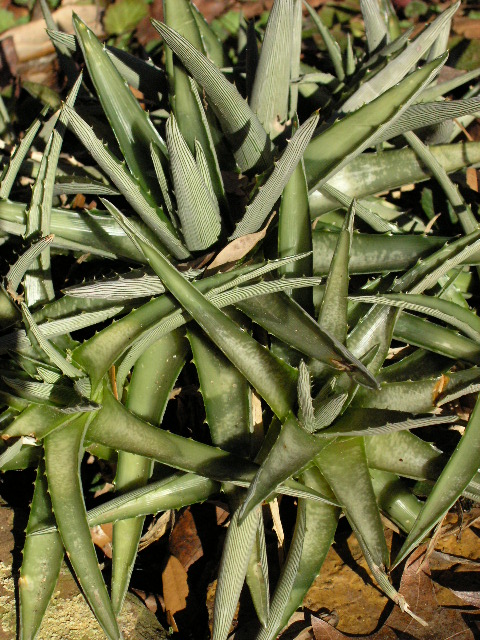
The Dyckias are all looking a little sad - a combination of cold and cover weight. Some of the spiky leaves seem a little more pliable than normal. Will have to wait to see how well they recover, but I'm at least hopeful.
The Soap Aloes (Aloe saponaria) got hammered. For that length of cold, covers made no difference. They likely would have benefited from the addition of a light source for warmth, but that would be difficult as they are widely scattered around the yard.
But at least some of the pups appear to be firm and strong, so there is a chance some will survive and grow from these.
The Aloe 'Hedgehog' (Aloe humilis 'Hedgehog') also got hit hard. Though it appears that some portions of the plant will likely survive, it will be significantly reduced. In the future, my succulent bed may get its own spotlight.
In the covered succulent bed along with some of the Aloes and Dyckias, this Manfreda looks rather sad. Species unknown, it has seemed less hardy as the 'Macho Mocha' - but the seller at the Austin Cactus & Succulent show said it would likely die back to the ground, but would return.
The Pittosporum Creme De Mint (Pittosporum tobira 'Shima') will, in the future, likely not even get covered. It only received special treatment this winter since it was a recent transplant. Though somehwat flattened, it appears to be in a good shape.
Much like the Pittosprum, the Sparkler Sedge (Carex phyllocephala 'Sparkler') primarily got protection due to their recent planting. All of them came through with little or no damage.
The vast majority of my plants are typically left to fend for themselves. In the near future, I will try to post a listing of those that show damage and those that looked bad but recovered.
For this posting, I'll examine the plants which were left outside but received some form of protection. (Will examine those left to fend for themselves on a subsequent posting.)
The Foxtail Fern (Asparagus densiflorus 'Meyersii') showed some minor damage, but actually came through in good shape (especially for a recently potted plant).
The two Sago Palms came through beautifully. Of course, not only did they receive a cover, but a spotlight was placed underneath each one to give some additional warmth. The light bulb trick made a huge difference.
The Dyckias are all looking a little sad - a combination of cold and cover weight. Some of the spiky leaves seem a little more pliable than normal. Will have to wait to see how well they recover, but I'm at least hopeful.
| Dyckia 'Cherry Coke' |
| Red-leafed Dyckia (Dyckia 'Red Devil') |
| Pineapple Dyckia (Dyckia brevifolia) |
| Bronze Dyckia (Dyckia fosteriana 'Bronze') |
| Dyckia platyphylla |
The Soap Aloes (Aloe saponaria) got hammered. For that length of cold, covers made no difference. They likely would have benefited from the addition of a light source for warmth, but that would be difficult as they are widely scattered around the yard.
But at least some of the pups appear to be firm and strong, so there is a chance some will survive and grow from these.
The Aloe 'Hedgehog' (Aloe humilis 'Hedgehog') also got hit hard. Though it appears that some portions of the plant will likely survive, it will be significantly reduced. In the future, my succulent bed may get its own spotlight.
In the covered succulent bed along with some of the Aloes and Dyckias, this Manfreda looks rather sad. Species unknown, it has seemed less hardy as the 'Macho Mocha' - but the seller at the Austin Cactus & Succulent show said it would likely die back to the ground, but would return.
The Pittosporum Creme De Mint (Pittosporum tobira 'Shima') will, in the future, likely not even get covered. It only received special treatment this winter since it was a recent transplant. Though somehwat flattened, it appears to be in a good shape.
Much like the Pittosprum, the Sparkler Sedge (Carex phyllocephala 'Sparkler') primarily got protection due to their recent planting. All of them came through with little or no damage.
The following seemed to have survived with varying degrees of damage:
- Anthony Waterer Spirea (Spiraea x bumalda 'Anthony Waterer')
- Amaryllis 'San Antonio Rose' (Hippeastrum 'San Antonio Rose')
- Bella Red Abutilon (Abutilon x hybridum 'Bella Red')
- Wood Betony (Stachys officinalis)
- Friendship Plants (Billbergia nutans) (though hard to tell)
The vast majority of my plants are typically left to fend for themselves. In the near future, I will try to post a listing of those that show damage and those that looked bad but recovered.
Wednesday, February 2, 2011
There Will Be Damage
Many central Texas gardeners looked at last winter's 18 degree low as extreme. So I guess this winter's freezing temperatures will have to be considered extremely extreme. Not only have we reached 17 degree lows, but will achieve it two nights in a row. While it is not uncommon for this area to drop pretty low, we typically bounce back to above freezing quite fast - often on the same day. This winter is unusual for us as we are expected to remain under freezing for an extended period: over 60 continuous hours at or below freezing.
So there will be damage. Prior to last night's freeze, I had already covered the plants (even purchasing a 10x20 foot cold cover to add to my collection of sheets, blankets & towels). Obviously, I don't have enough to cover everything, so choices had to be made.
Covered plants include:
But several plants are already showing signs of damage.
There are many others (but I was too wimpy to stay out in the cold taking snapshots!). Even the Cast Iron Plants (Aspidistra elatior) have an unusual darkness to their green color. Only time will tell which plants survive.
Planted in Pots:
So there will be damage. Prior to last night's freeze, I had already covered the plants (even purchasing a 10x20 foot cold cover to add to my collection of sheets, blankets & towels). Obviously, I don't have enough to cover everything, so choices had to be made.
Covered plants include:
- Sago Palms (even place spotlight under the cover with them for some extra warmth)
- recently potted Anthony Waterer Spirea (Spiraea x bumalda 'Anthony Waterer')
- potted Foxtail Fern (Asparagus densiflorus 'Meyersii')
- Soap Aloes (Aloe maculata)
- Aloe 'Hedgehog' (Aloe humilis 'Hedgehog')
- all Dyckias
- some Amaryllis 'San Antonio Rose' (Hippeastrum 'San Antonio Rose')
- Bella Red Abutilon (Abutilon x hybridum 'Bella Red'),
- recently planted Pittosporum Creme De Mint (Pittosporum tobira 'Shima')
- recently planted Sparkler Sedge (Carex phyllocephala 'Sparkler')
- recently planted Wood Betony (Stachys officinalis)
- some Friendship Plants (Billbergia nutans)
But several plants are already showing signs of damage.
Gold Dust Plant (Aucuba japonica 'Variegata')
Bear's Breech (Acanthus 'Summer Beauty')
Formosa Red Azalea (Azalea indica 'Formosa Red')
Joe Pye Shrub
There are many others (but I was too wimpy to stay out in the cold taking snapshots!). Even the Cast Iron Plants (Aspidistra elatior) have an unusual darkness to their green color. Only time will tell which plants survive.
Planted in Pots:
- Anthony Waterer Spirea (Spiraea x bumalda 'Anthony Waterer'): put it in large pot about a week ago - hope it makes it through this cold.
Tuesday, October 19, 2010
Viburnum Munched
Yesterday, I discovered that my Reifler's Dwarf Viburnum (Viburnum obovatum 'Reifler Dwarf') seemed to be losing its leaves. Couldn't quite determine if they had been munched or were falling off. It had been doing quite well and I was looking forward to its fall color and hopefully next years blooms. So I was a wee bit perturbed.
Then, this evening, I checked it again and discovered the culprit:
Or should I say culprits!
I didn't even know that hornworms ate Viburnums. But even though I don't know the variety of these guys, they obviously have a taste for for the plant. Grumble, grumble.
Needless to say, they have now departed the garden.
Planted in the Ground:
Planted in Pots:
Then, this evening, I checked it again and discovered the culprit:
Or should I say culprits!
I didn't even know that hornworms ate Viburnums. But even though I don't know the variety of these guys, they obviously have a taste for for the plant. Grumble, grumble.
Needless to say, they have now departed the garden.
Planted in the Ground:
- Mexican Petunias (Ruellia tweediana 'Colobe Pink'): Added three more to the pond area as they tend to be evergreen in a typical winter
- Gulf Coast Penstemon (Penstemon tenuis): Added three more to the existing small patch to help thicken up the area; hoping this will make for an even better spring showing
- Ghost Plant (Graptopetalum paraguayense): Two more added - one in a dry area near the path and another in the recently created succulent bed (not pictured).
- Lady Tulips 'Cynthia' (Tulipa clusiana 'Cynthia'): Ten more placed into the bed near the pond (not pictured)
Planted in Pots:
- Foxtail Fern (Asparagus densiflorus 'Meyersii'): Have one in the ground; decided to try one in a pot. Not entirely sure if it is winter hardy, but plan on leaving it out (so I guess I'll learn!)
Subscribe to:
Posts (Atom)