Thursday, May 6, 2010

A Hole In The Canopy Means...

Late last fall, one of my trees collapsed, removing both itself and another from my shady canopy.  Suddenly, a limited area of my yard was receiving...sunlight!  Not my usual stuff the peeks in and out of the upper story foliage, but the real thing.  Up to six hours of it.  The mind raced with possibilities.

Fall /Winter/Early Spring - "I'm going to plant some flowering shrubs, maybe even (gasp) a rose bush!  And possibly some of those flowers that are rumored to grow in these parts.  And a couple of pots with Dill - perhaps I can attract those swallowtail butterflies everyone seems to have in their yards.

Today - "Oh yeah.  That's right.  The existing plants sorta liked the shade.  And now they are getting...ummm, well, rather...cooked..."


"...and sunburned..and fried.  Well, ummm...guess I kinda forgot about y'all..."


"And now its getting a little too hot to be digging up plants your size and moving you elsewhere.  Sure woulda been nice to get that done...ummm, earlier.  Here's a fair bit of water and, ummm, I guess, maybe, I can start building you a little shade structure to get you through till next fall...hopefully...possibly..."


A hole in the canopy means a chance to grow some sun-loving plants, but it also means you'd better start moving out the shade-loving ones.

Saturday, May 1, 2010

Autumn Ferns

The favored fern of my shady central Texas garden is the Autumn Fern (Dryopteris erythrosora).


I have tried several other fern varieties.  Some were unable to handle the summer heat and drought while others were dissatisfied with my yard's low light levels.  Nearly all would disappear back to the ground after the first frost - returning diminished the following spring or never appearing again at all.


But the Autumn Fern hasn't disappointed.  It begins spring by sending up several reddish fiddleheads which slowly unfurl to present rusty colored fronds.  The fronds gradually lose their reddish hues as, over several weeks, they change to green.


They are more drought tolerant than many fern varieties, surviving on the same level of watering as most lawn grasses.  And either early morning sunshine or all day filtered sunlight meets its light needs.


And come winter's freezes, the Autumn Fern stays evergreen, its fronds withstanding our past winter's 18 degree lows with little or no damage.


With evening coming on, the sunshine angles through the trees and backlights the raised fronds. 

Sunday, April 25, 2010

Week In The Garden

Earlier in the week, I realized that my presence was agitating a hummingbird in the tree above me.  After a few minutes of observation, I discovered that the little female was building a nest.  She'd zip in with a tiny piece of white fluff held in the tip of her bill, land on the nest, do some quick actions, then buzz away again.  The picture isn't sharp, but that's her sitting in the nest in the center of the photo.  This is the first hummingbird nest I've ever discovered in the yard.


Back to its original location from last year, I planted one of the cuttings I made from the Beefsteak Plant (Perilla  'Magilla') in one of the front yard beds.  It did quit nicely there previously, growing to almost four foot.  Here's hoping I get the same results this year (and I've still got more cuttings to try elsewhere).


Finally changed the status of my two Mexican Turk's Cap (Malvaviscus arboreus var. mexicanus) from dormant to dead.  Same is also true of a few plants that were transplanted right before the big freezes hit: Coral Nymph Sage (Salvia coccinea 'Coral Nymph'), Smooth-Leaf Sage (Salvia miniata) & Pink Dianthera (Dianthera candicans).  I guess the winter's 18 degrees was just too low or too soon.

So in to some of these vacant spots (plus some that were empty to begin with), I did some planting.  A Giant Spiderwort (Tradescantia gigantea), already looking wilted, went behind some Liriope.  Three Red Columbine (Aquilegia canadensis) and three Lyreleaf Sage (Salvia lyrata) went into the backyard beds.  Have tried both with limited to no success in the past, but it appears the time has come for another attempt.

Been on the lookout for Husker's Red Penstemon (Penstemon digitalis 'Husker's Red'), and I finally captured this elusive quarry.  Really like the red coloration in the leaves, and I'm hopeful that it will bloom as well my other penstemons.


In a deeply shady section, where it can cascade over some railroad ties, I'm trying the Spreading Plum Yew (Cephalotaxus harringtonia 'Prostrata').  It is supposed to do well even in significant shade, so I'm interested to see how it does for me.  The picture was taken during the sunniest part of the day for this spot: it gets maybe 1-2 hours of dappled light and then no direct sun the remainder of the time.


To fill in the holes made by the deceased Mexican Turk's Caps, I'm trying two plants that are new to my shady garden: Goldmound Spirea (Spiraea japonica 'Goldmound') & White Margin Snow Rose (Serissa foetida 'Improved').

The Goldmound Spirea is covered in chartreuse foliage which really stands out in the dappled shade.  It presently has several unopened buds destined to be clusters of tiny light pink flowers.  Wouldn't be surprised if this is the only year it blooms, but I'm mainly interested in those neon leaves anyway (though I certainly wouldn't turn away any returning blooms!).


I was completely unfamiliar with White Margin Snow Rose, so this was a nice discovery.  The small variegated leaves are joined by occasional tiny white blossoms.  But, again, its the foliage that steals the show.


Beautiful weekend to be in the garden...

Wednesday, April 21, 2010

Cedar Sages Take a Bow (Sadly)

My garden's three Cedar Sages (Salvia roemeriana) came back strong this year, rising up from the ground and then throwing out stalks of brilliant red flowers beside the backyard path.


Then came last week's rains.  And the Cedar Sages took an unfortunate bow.


I believe the same thing happened last year.  Does this happen to your Cedar Sages?


There must be a trick to keeping them upright.  I guess I need to be more proactive.  Perhaps some type of bloom stakes or grow-through supports?  Maybe etiquette lessons on proper posture?


And what to do post-collapse?  Enjoy the brilliant, though vertically challenged, flowers?  Snip them off and transfer them to a vase?  I assume snipping will encourage additional blooms.


I guess I'll look at this as an opportunity to bring some fresh cut flowers inside the house...

Tuesday, April 20, 2010

Recently...

Have been somewhat amiss on keeping up with the small happenings in the garden.  So I decided to group some of the events that have occurred over the last ten days into this single posting.

About a week ago, another variety of mushrooms made a surprise appearance.  I especially liked the ribbed view from above.  As with almost all of these fungi, they disappeared back into the soil within a couple of days.


The Chickadee brood has been keeping the parents busy.  While working in the garden, I have gotten to watch the parents flying in & out, making sure the youngsters stay well fed.  But all appeared quiet today, and upon checking, it looks as if the nestlings have departed.


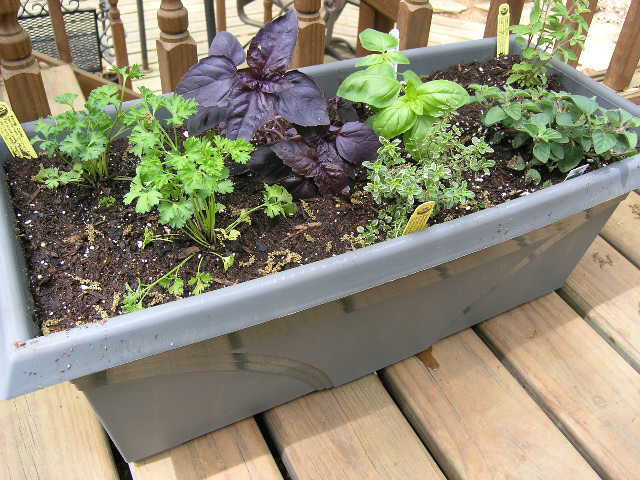
Me & the missus are delving into new territory by creating a small herb garden (parsley, basil, oregano & thyme).  Not sure if we have sufficient light, but I can at least move the plants around on the deck in an attempt to locate an optimum spot.


Recent rains seems to have brought out the critters - both beneficial and no so beneficial.


The Sweet Kate Spiderwort (Tradescantia x andersoniana 'Sweet Kate') has been sending its lime green shoots ever higher.  The bright coloration lasts until the summer heat sets, then slowly darkens.  No blooms yet.


But a couple of other plants are producing their first blooms of the year for my shady garden.

Jerusalem Sage

Lenten Rose

I also finally got around to potting the Golden Tooth Aloe (Aloe perfoliata) that I got at the recent Cactus & Succulent Show.  Included in the pot is a low growing Sedum (variety unknown).


Then I decided to get experimental and created the first hanging basket of my garden using the Ghost Plant (Graptopetalum paraguayense).  I was inspired to try this by a couple of  postings: Tough Decisions on Rock Rose and Hanging Succulent Gardens on Danger Garden (be sure to check them out!).  Looks a little empty now, but I have faith (for now).


Been a busy time.  It's good to get caught up with the recent happenings.

Green World


Each month, Gardening Gone Wild sponsors the "Picture This" photo contest with April's theme being "Green World".  Numerous outstanding entries can be viewed at the site & I highly recommend that you check it out.  My entry for this month was inspired by the annual renewal of the ferns;  their numerous bright green fronds unfurling outward.

Sunday, April 18, 2010

Strawberry Begonia/Geranium

Strawberry Begonia or Strawberry Geranium (Saxifraga stolonifera): I must not be able to make up my mind which name to use because I swap back & forth from moment to moment.  Some of my recent postings included pictures of its diminutive asymmetrical blossom, and that seems to have sparked some interest.


The individual blossom is slightly smaller than a dime, so you have to lean close to see the delicate intricacies and pink highlights of the flower.  Several flower stalks, each supporting ten or more blooms, rise above the variegated foliage, creating a hovering cloud of white.


Several of the stalk's blossoms will open simultaneously, and more will continue to open over time.  The blooms last several days, so the show is likely to last nearly a month.


Growing in filtered shade, the blossoms are not its only attribute.  Even when not in bloom, the 3 inch tall mat of variegated foliage is quite eye-catching.  It has slowly spread outward from the planting site; the three original plants have about doubled their coverage in a year.


The evergreen leaves made it through our recent 18 degree winter without protection.  The plant did seem to "shrink" some during the winter, though I did not witness any damage to the plant.  Perhaps leaf litter simply buried some of them.

 
Leaves that have been accidentally broken off, can easily be rooted by simply placing them in to moist potting soil.  I have transferred a couple of transplants created in this manner to a much shadier area (under a thick boxwood), and though a little early to tell, they seem to be doing well.


For gardeners looking for something a little different in their shady spot, you might consider the Strawberry Begonia.  Or maybe even the Strawberry Geranium.