Over the last month, there has been a few additions to my Aloe collection. At the last Oracle Gorge Nursery sale, spotted a couple of nice-looking new varieties that I was able to bring home. Haven't had time to get any of them into new pots.
Really liked the pale coloration of the Aloe pictifolia - it almost appears to have a been lightly coated with a thin whitewash.
On the other end of the color scale is the bright green Aloe juncunda. This variety tends to remain small and grow into a mounding cluster.
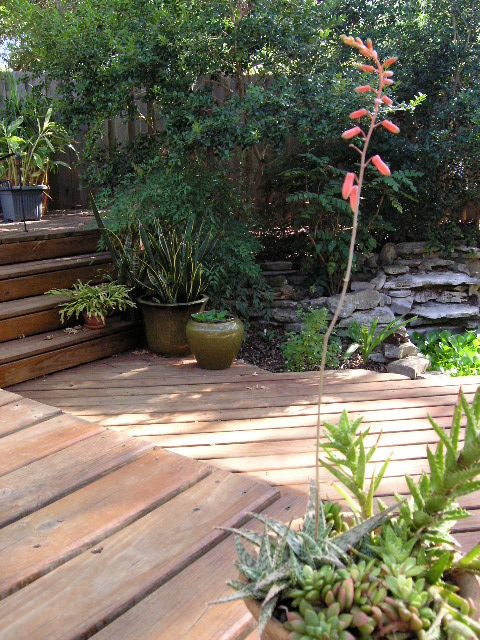
Another couple of "additions" weren't new Aloes - but were instead new Aloe blooms. For the Lace Aloe (Aloe aristata) , this is the first time it has bloomed in my garden. The stalk has a definite curl to it which straightened somewhat after a watering.
Most of my Soap Aloes (Aloe maculata) are actually planted in the ground, but one specimen is actually contained within a pot - and is blooming for the first time (all of my in-ground ones are growing and recovering for our past severe winter).
In our ongoing drought and heat (so far every day in August - except one - with a high temperature over 100 degrees), Aloes are certainly a plant variety that does well.
Tuesday, August 23, 2011
Monday, August 15, 2011
Flower Power: GBBD August 2011
May Dream Gardens invites everyone, on the fifteenth of the month, to share the blooms found in their gardens. With our ongoing heat & drought, flowers are pretty rare in my garden.
Established Plants
Water plants account for almost all my blooms. The Water Poppy (Hydrocleys nymphoides) has taken over the pond and puts out plenty of its yellow blooms.
Rising high above the pond surface, the Aztec Arrowhead (Sagittaria montevidensis) has a nice cluster of brilliant white blooms that shine in the filtered sunshine.
Potted Plants
Only a single bloom remains on the Ground Orchid (Spathoglottis plicata). Its small cluster of purple flowers has been fading, but at least this one is still hanging in there.
Flower Wannabes
The berries of the American Beautyberry (Callicarpa americana) are just starting to change from green to their deep purple color.
Be sure to visit May Dream Gardens to see what flowers are shining in other's gardens.
Established Plants
Water plants account for almost all my blooms. The Water Poppy (Hydrocleys nymphoides) has taken over the pond and puts out plenty of its yellow blooms.
Rising high above the pond surface, the Aztec Arrowhead (Sagittaria montevidensis) has a nice cluster of brilliant white blooms that shine in the filtered sunshine.
Potted Plants
Only a single bloom remains on the Ground Orchid (Spathoglottis plicata). Its small cluster of purple flowers has been fading, but at least this one is still hanging in there.
Flower Wannabes
The berries of the American Beautyberry (Callicarpa americana) are just starting to change from green to their deep purple color.
Be sure to visit May Dream Gardens to see what flowers are shining in other's gardens.
Sunday, July 31, 2011
How to Kill a Bed in Three Easy Steps
Step 1: Get as close to summer as you can before placing your plants into the ground.
I waited until May 20 before placing the thirteen Autumn Ferns (Dryopteris erythrosora) into the middle tier of my Three Tiers Bed. Would have preferred to have accomplished this sooner, but was unable to find the desired size & price until late in the season. Might have been better to just leave it bare until fall.
Step 2: Trim lower tree limbs to expose previously dappled shade bed to intense shaft of sunlight.
Last summer, this bed received dappled sun for most of the summer day. But after having some tree trimming done to remove lower limbs and get branches away from the house, the bed still gets the dappled sunlight but also additionally receives two hours of direct late afternoon sun. Which helps a lot if you desire fried plants.
Step 3: Be sure to schedule an ongoing extreme drought and intense summer temperatures.
A steady stream of above 100 degree days combined with a complete lack of moisture have combined to desiccate the soil layer to the utmost level of aridity. Tried to provide assistance with sporadic showers from the hose - but with our present weather conditions, just haven't been able to keep pace with the moisture loss.
So there you have it, three simple steps to wiping out a new garden bed.
I waited until May 20 before placing the thirteen Autumn Ferns (Dryopteris erythrosora) into the middle tier of my Three Tiers Bed. Would have preferred to have accomplished this sooner, but was unable to find the desired size & price until late in the season. Might have been better to just leave it bare until fall.
Step 2: Trim lower tree limbs to expose previously dappled shade bed to intense shaft of sunlight.
Last summer, this bed received dappled sun for most of the summer day. But after having some tree trimming done to remove lower limbs and get branches away from the house, the bed still gets the dappled sunlight but also additionally receives two hours of direct late afternoon sun. Which helps a lot if you desire fried plants.
Step 3: Be sure to schedule an ongoing extreme drought and intense summer temperatures.
A steady stream of above 100 degree days combined with a complete lack of moisture have combined to desiccate the soil layer to the utmost level of aridity. Tried to provide assistance with sporadic showers from the hose - but with our present weather conditions, just haven't been able to keep pace with the moisture loss.
So there you have it, three simple steps to wiping out a new garden bed.
Saturday, July 16, 2011
Foliage Follow-up: July 2011
Flowers are great, but the majority of the plant is its foliage - so Digging invites us to celebrate this by posting some pictures of the leaves that make up most of our gardens' show. I decided to concentrate on a few of the plants that seem to be handling our extreme drought and heat better than the rest of my tired, dry collection. All but one are planted in pots - so maybe that is making the difference.
Originally planted in the ground where it struggled, the Star Begonia (Begonia heracleifolia) produced a nice set of blooms this spring and then, as the temperatures increased, it really started putting out the leaves. It has grown four times bigger than it has ever managed before. It's large palmate leaves and hairy stems are quite unique.
Quickly becoming my favorite Aloe, the Lace Aloe (Aloe aristata) has continued to look good and slowly add additional size. Though it has never bloomed, its foliage is extremely attractive and quite different than any of my other Aloes.
Another Aloe that is doing well is the Vuurpylaalwyn (Aloe peglerae) - gotta love a name like that! Almost appearing Agave-like, its leaves have thorns along both its sides and even the underside edge. Appearing quite fearsome, it has been doing well in the heat with only occasional splashes of water.
The only highlighted specimen actually planted in the ground, the Dyckia 'Cherry Coke' has to compete with the trees and other plants for moisture. But it is doing great (and was the only Dyckia to make it through last winter's extreme cold snap with little to no damage). Starting the year off with a green cast, increased sunshine and temperature has caused it to develop a nice reddish hue.
Be sure to visit Digging to see the foliage that is stealing the show in other gardens.
Originally planted in the ground where it struggled, the Star Begonia (Begonia heracleifolia) produced a nice set of blooms this spring and then, as the temperatures increased, it really started putting out the leaves. It has grown four times bigger than it has ever managed before. It's large palmate leaves and hairy stems are quite unique.
Quickly becoming my favorite Aloe, the Lace Aloe (Aloe aristata) has continued to look good and slowly add additional size. Though it has never bloomed, its foliage is extremely attractive and quite different than any of my other Aloes.
Another Aloe that is doing well is the Vuurpylaalwyn (Aloe peglerae) - gotta love a name like that! Almost appearing Agave-like, its leaves have thorns along both its sides and even the underside edge. Appearing quite fearsome, it has been doing well in the heat with only occasional splashes of water.
The only highlighted specimen actually planted in the ground, the Dyckia 'Cherry Coke' has to compete with the trees and other plants for moisture. But it is doing great (and was the only Dyckia to make it through last winter's extreme cold snap with little to no damage). Starting the year off with a green cast, increased sunshine and temperature has caused it to develop a nice reddish hue.
Be sure to visit Digging to see the foliage that is stealing the show in other gardens.
Friday, July 15, 2011
Flower Power: GBBD July 2011
On the fifteenth of every month, May Dream Gardens invites us to post pictures of the plants that are blooming in our gardens. With our continuing drought, extreme heat and, of course, my ever present shade, blooms are rare and are typically only found as singletons.
Established Plants
Still sporadically producing rainless blooms, the Zephyr Lilies (Zephyranthes 'Labuffarosea') surprises with the occasional flower - though it fades quickly in the heat.
Another surprise is the additional blooms coming from the Chinese Indigo (Indigofera kirilowii) which generally has only flowered in the spring.
Rock Rose (Pavonia lasiopetala) is, of course, still going strong with its bright pink blooms - though only 1-4 blooms at a time on the plant.
Likely the strongest blooming plant presently in the garden, the Water Poppy (Hydrocleys nymphoides) has taken over the pond, completely covering the surface except where the waterfall splashes down.
Another pond plant, the Aztec Arrowhead (Sagittaria montevidensis) has yet another bloom stalk just beginning to erupt with its tri-petaled flowers.
New Plants in the Garden
On the tips of its sprawling limbs, the Pale Pavonia (Pavonia hastata) will sometimes produce its brilliant white flower.
Potted Plants
Aloe 'Doran Black' has had several flower stalks this year, with the latest blooms still going strong.
None of the Ground Orchids (Spathoglottis plicata) planted in the ground survived our winter, but this potted specimen that was protected has started to flower once again.
Indoor Plants
Finally slowing down, only two of my Moth Orchids (Phalaenopsis sp.) have any remaining blooms - and only five total between them - but after appearing in five straight GBBDs, I certainly can't complain.
Tardies
Seeming to enjoy our hot, dry weather, the Ox Tongue (Gasteria liliputana) tried to get its flowers open for GBBD - but is going to just miss attending.
Be sure to visit May Dream Gardens and see what is flowering in other's gardens.
Established Plants
Still sporadically producing rainless blooms, the Zephyr Lilies (Zephyranthes 'Labuffarosea') surprises with the occasional flower - though it fades quickly in the heat.
Another surprise is the additional blooms coming from the Chinese Indigo (Indigofera kirilowii) which generally has only flowered in the spring.
Rock Rose (Pavonia lasiopetala) is, of course, still going strong with its bright pink blooms - though only 1-4 blooms at a time on the plant.
Likely the strongest blooming plant presently in the garden, the Water Poppy (Hydrocleys nymphoides) has taken over the pond, completely covering the surface except where the waterfall splashes down.
Another pond plant, the Aztec Arrowhead (Sagittaria montevidensis) has yet another bloom stalk just beginning to erupt with its tri-petaled flowers.
New Plants in the Garden
On the tips of its sprawling limbs, the Pale Pavonia (Pavonia hastata) will sometimes produce its brilliant white flower.
Potted Plants
Aloe 'Doran Black' has had several flower stalks this year, with the latest blooms still going strong.
None of the Ground Orchids (Spathoglottis plicata) planted in the ground survived our winter, but this potted specimen that was protected has started to flower once again.
Indoor Plants
Finally slowing down, only two of my Moth Orchids (Phalaenopsis sp.) have any remaining blooms - and only five total between them - but after appearing in five straight GBBDs, I certainly can't complain.
Tardies
Seeming to enjoy our hot, dry weather, the Ox Tongue (Gasteria liliputana) tried to get its flowers open for GBBD - but is going to just miss attending.
Be sure to visit May Dream Gardens and see what is flowering in other's gardens.
Sunday, July 10, 2011
Rise & Fall of the Tricolor Ginger
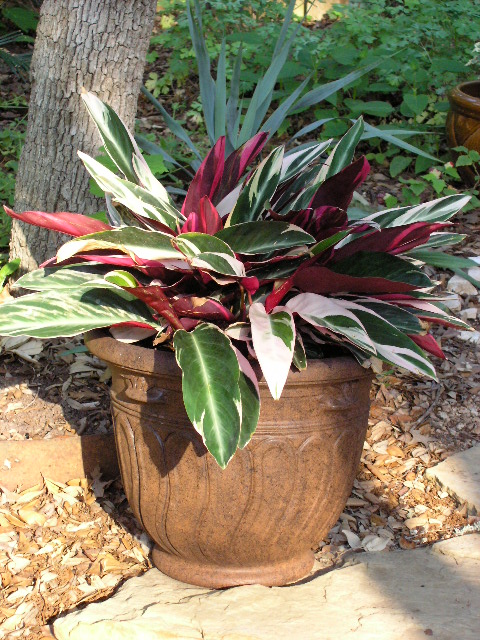
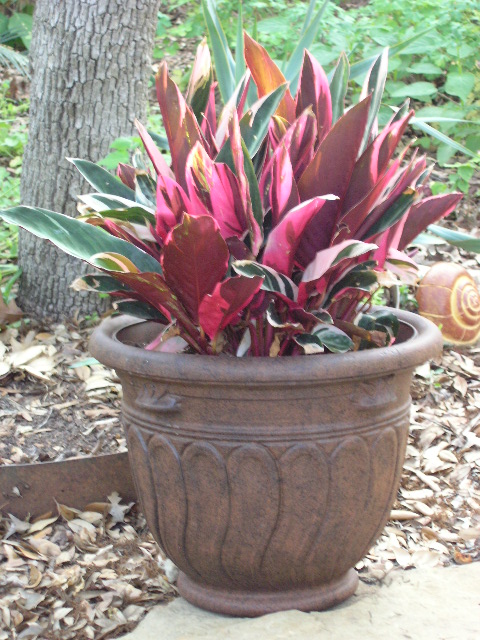
The leaves of the Tricolor Ginger (Stromanthe sanguinea 'Triostar') tend to follow a daily pattern. As the morning begins, the leaves are scattered and widespread (similar to one's hair upon first arising).
A couple of hours later, as the day heats up, some of the leaves have started to curl slightly, showing more of their purple undersides.
By early afternoon, the leaves are showing more curl and several have begun to lift themselves up.
By the time evening approaches and the sun starts to set, the leaves have stretched upwards as far as they can reach, showing much of their purple undersides.
During the evening, the leaves will again lower themselves and uncurl, ready to start the entire cycle again the next day. Makes for a rather fun show.
A couple of hours later, as the day heats up, some of the leaves have started to curl slightly, showing more of their purple undersides.
By early afternoon, the leaves are showing more curl and several have begun to lift themselves up.
By the time evening approaches and the sun starts to set, the leaves have stretched upwards as far as they can reach, showing much of their purple undersides.
During the evening, the leaves will again lower themselves and uncurl, ready to start the entire cycle again the next day. Makes for a rather fun show.
Thursday, July 7, 2011
I'd Plant Plastic Flowers...
...but I'm afraid they'd melt.
This past June was recorded as the second hottest ever for Austin. And we are easily on pace to set a record for the most 100+ degree days to occur over the calender year.
And the drought continues. You know its bad when the weatherman gets excited over a predicted 10% rain chance - a week from now.
Can barely keep up with the demand for water from the potted plants. Those in the ground are mostly left to fend for themselves.
Really could use some rain.
And the drought continues. You know its bad when the weatherman gets excited over a predicted 10% rain chance - a week from now.
Can barely keep up with the demand for water from the potted plants. Those in the ground are mostly left to fend for themselves.
Really could use some rain.
Subscribe to:
Posts (Atom)