Showing posts with label Persicaria. Show all posts

Sunday, May 15, 2011

Flower Power: GBBD May 2011

On the fifteenth of every month, May Dream Gardens invites us to share the plants that are blooming in our gardens.  Between the drought and high spring temperatures, many of my plants are either no longer blooming or are in the final stages.

Established Plants

A recent rain shower (thank goodness!) inspired the Pink Rain Lilies (Zephyranthes rosea) to produce a few blooms in celebration.  The first wave is fading, but others are still on the way.

In last stages of its bloom period, the Dwarf Gardenia (Gardenia jasminoides 'Radicans') still has a couple of its fragrant blossoms open.  They tend not to last long outside, as they get snipped and brought inside so we can enjoy their perfume.

Likely to continue going strong all summer, the pond plant Aztec Arrowhead (Sagittaria montevidensis) is already on its second bloom stalk.

Fading in the heat, I'm hoping that a good shearing will help the Anthony Waterer Spirea (Spiraea x bumalda 'Anthony Waterer') to produce another wave of the magenta flower clusters.

Moved deeper into the shade, the Red Dragon Knoweed (Persicaria microcephala 'Red Dragon') seems to be quite happy.  Time will tell as summer's heat has, in the past, made it look quite tired.  I'm hoping the increased shade will help it out during those times.

Rock Rose (Pavonia lasiopetala), of course, can always be counted on to put on a show with its intensely pink blooms.  It tends to get lanky in my shade, so I must remember to shear them back on occasion.

Some of the initial flowers of the West Texas Mist Flower (Conoclinium greggii) are looking tired, but this is just the first crest of a summer long purple wave.

They don't last long, but the blooms of the Crinum (species unknown) are quite eye-catching when at their peak.  Already fading, it will sometimes produce a second wave of bloom stalks (here's hoping).

New Plants in the Garden

I am very pleased with the Oakleaf Hydrangea 'Alice' (Hydrangea quercifolia 'Alice') in its first spring in the shade.  Though it only produced two clusters of long lasting flowers, it has almost doubled in size - so next years show looks quite promising.

This is as close to a "flower" as Sparkler Sedge (Carex phyllocephala 'Sparkler') will ever get, but it was fun to discover the inflorescence while looking about the garden.

Potted Plants

Though starting to fade, the flowers of the Orange Kaffir Lily (Clivia miniata) are still showing intense color that catches the eye.

The only rose that has at least survived in my shady garden, I have never known the exact name of this Old-fashioned Rose.  It produces a few small blooms throughout the summer.

A pass-along from Robin (Getting Grounded) that I over-wintered inside, the Bleeding Heart Vine (Clerodendrum thomsoniae) has not grown much yet.  But it has still been able to produce a small group of blooms.

Indoor Plants

Still going strong, the flowers of the Moth Orchids (Phalaenopsis sp.) just seem to last forever.  The first couple of pictures are from plants that are just now opening their flower buds.  But the others have been putting on a show for over a month.


Tardies

Hit hard by this winter's extremes, only a single flower stalk is rising from the recovering Lily of the Nile (Agapanthus africanus).

Also recovering from the lengthy winter freezes, the Amaryllis 'San Antonio Rose' (Hippeastrum 'San Antonio Rose') are nonetheless producing several flower stalks.  Soon the red blooms will add color to this area of the garden.

Be sure to visit May Dream Gardens to see what is blooming in other gardens.

Planted in the Ground:
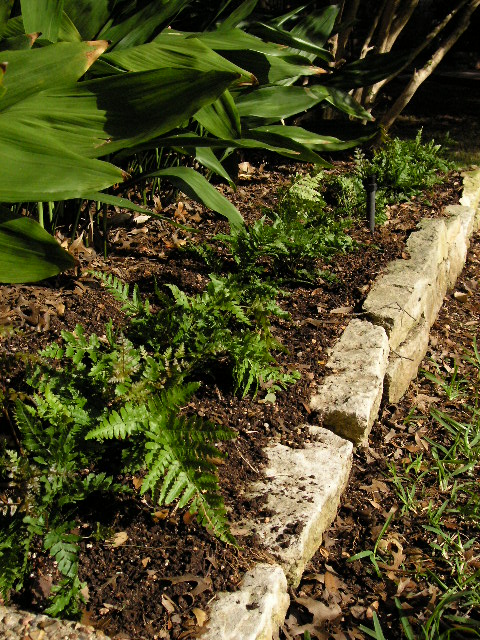
  • Autumn Fern (Dryopteris erythrosora): Already had several on the left side of my front beds; finally got around to adding thirteen to the right side.
Sunday, February 27, 2011

Shady Happenings: Late February

I have been slowly removing and trimming back remnants of this winter's damage.   Cast Iron Plants (Aspidistra elatior) are tough, but there is always some damage even during milder winters.  But our unusually extreme cold snap seems to have hit the Milky Way Cast Iron Plant (Aspidistra lurida 'Milky Way') even harder.  I had to trim away almost all its leaves, though it should grow back just fine.


One of the aspects that I enjoy about the Red Dragon Knotweed (Persicaria microcephala 'Red Dragon') is the coloration of its new growth when it emerges in spring.  The two-toned deep burgundy color is very attractive.


I overwintered two Gold Dust Plants (Aucuba japonica 'Variegata') in nursery pots as I have not yet determined exactly where I want them in the garden.  Both ended up doing something I had never seen before: they're blooming!  They have clusters of tiny green and reddish-brown flowers.


Another plant that I rarely see bloom, but is currently doing so, is the Wandering Jew (Tradescantia zebrina).  Kept in the pop-up greenhouse over the winter, its little lavender flowers make its relationship to the yard's  spiderworts quite obvious.


Have also been doing some planting of recent purchases.  Though likely it will want more sunshine than I can provide, I couldn't pass up the amazing foliage of the 'Mrs. Pollock' Geranium (Pelargonium x hortorum 'Mrs. Pollock').  Even if the plant, due to insufficient light, never produces any blooms, I'll be pleased if it just produces leaves!


Another new plant added to the garden is Red Billbergia (Billbergia sp. 'Red').  In the past, I have enjoyed my Friendship Plants (Billbergia nutans) though this past hard winter certainly caused them some serious damage.  But if this Billbergia, with its attractive reddish foliage, can do as well - then I'll be quite happy.


Planted in the Ground
  • Rosemary 'Lockwood de Forest' (Rosmarinus officinalis 'Lockwood de Forest'): Planted in the utility side of the garden where a fallen tree opened the canopy; though wasn't enough sunshine for a Rose to make it there.  Here's hoping a Rosemary can.
  • Seeds of Dill, Parsley & Thyme

Wednesday, December 29, 2010

First Winter Freeze: 2010

Though several other Austin gardens reported freezing temperatures as far back as a month ago, my garden had only received the slightest of touches from winter's cold hands - none of the plants even showing damage (though the leaves were certainly falling from the trees).  But in the last few days, my garden finally received a good freeze setting a few of the plants back to their protected roots where they'll await next spring's warmth.

The Red Christmas Pride (Ruellia amoena) always get zapped back to the ground.  The three found in my garden have been slow to return each year and are slowly disappearing - am thinking this may very well be their last hurrah.

I am hoping that the Salvia van houttei can return from its roots (most of my Salvias do).  It was bravely trying to bloom right up to the end.
 

The potted Root Beer Plant (Piper auritum) leaves turned into the soggy handkerchiefs as always documented by Philip at East Side Patch (from whom I received the plant as a pass-along).

The three Dwarf Mexican Firebush (Hamelia patens 'Compacta') had shown some promising growth during the year so it will be interesting to see if they can return to form next spring.  Though I'd like to see even stronger growth if I am to retain them.

I deliberately left the Hedychium 'Tahitian Flame' out so that the foliage would get nipped back - wanted to see how low it could go and how (if?) it recovers next spring.

Others that received at least a little leaf damage:
  • Southern Wood Fern (Dryopteris normalis): lost about half their fronds
  • Philippine Violets (Barleria cristata): now have mostly crunchy leaves
  • Mountain Sage (Salvia regla): ditto for this plant
  • Toad Lily (Tricyrtis lasiocarpa): both potted and in ground showing some die-back
  • Ground Orchid (Spathoglottis plicata): show some damage (though that may have begun even earlier; one of them is potted and safe in the house - and even blooming)
  • Blue Anise Sage (Salvia guaranitica 'Black and Blue'): still mostly green, but some minor damage
  • Red Dragon Knotweed (Persicaria microcephala 'Red Dragon'): typically dies back in winter, then comes back strong next spring
  • Crinums: all have minor leaf damage, but still mostly green (the ones I've had for years always die back to ground; not sure what new ones will do)
  • Banana Tree: in a pot; wanted some die back this year (got my wish).

Saturday, May 15, 2010

Flower Power: GBBD May 2010

May Dream Gardens hosts Garden Blogger's Bloom Day every month.  Blooms in my May shady garden tend to be scattered individuals, but its still fun to see the small splashes of colors.  Here's what is blooming in my garden:

New Plants in the Garden

Anthony Waterer Spirea (Spiraea x bumalda 'Anthony Waterer') may need a little more sun and acid than it is getting presently, but it still put out a few clusters of flowers.

Goldmound Spirea (Spiraea japonica 'Goldmound') still has a few faint pink clusters also.

Dyckia fosteriana, growing right at the base of a Red Oak, produces blossoms that are actually more orange than shown in the picture.

Pink Shamrock (Oxalis crassipes 'Rosea') is constantly producing additional little pink blooms.

My other shamrock, White Shamrock (Oxalis crassipes 'Alba'), doesn't seem to make as many blooms, but still manages to put out some.

Established Plants

Texas Betony (Stachys coccinea) has finished its primary bloom cycle, but still has a few blossoms here and there.

Cedar Sage (Salvia roemeriana) continues to throw out vertically challenged bloom stalks.

'Ragin' Cajun' Ruellia (Ruellia elegans 'Ragin' Cajun') has re-emerged from underground; still getting this year's growth started, it also managed to throw out a couple of blooms.

If my memory is correct, Red Dragon Knotweed (Persicaria microcephala 'Red Dragon') mainly produces its blossoms in the fall.  But a few are appearing here in the spring.

Yeah, I know.  It's bad, it's evil.  But Nandina domestica grows & blooms in my shade, and its red berries in the fall are lovely. 

Annual

The bronze-leafed begonias (Begonia x semperflorens-cultorum) continue to explode in pink blossoms.  I'm not too big on annuals, but I can't pass up the begonia's zealous bloom production.

Potted Plants

The Chrysanthemum still puts out a flower now and again.

The Red Yucca's (Hesperaloe parviflora) bloom stalk has skyrocketed upward, and is now unfurling its limbs of red blooms.

Bear's Breech (Acanthus 'Summer Beauty') is sending up two flower spikes which tend to last quite a while.  The unique blossoms occur at almost symmetrically precise steps along the stalk.

Hope you are enjoying your own bloom day!

Friday, April 16, 2010

Foliage Follow-Up: April 2010

Now that we've celebrated my shady blossoms, its time to turn our attention to the foliage.

I have slowly learned that a shady garden is really a leafy garden.  I often give in to blossom envy; purchasing plants that, fresh from the nursery, bloom that first year, but only feebly thereafter.  Thus my garden has shown me that I'd better pay attention to plants that are grown predominately for their foliage.

Here are a few that were selected with that specifically in mind:

Red Dragon Knotweed
Frozen to the ground this past winter, it is coming back strong.  Initial growth from the ground was burgundy, but with warmer temperatures it has developed into its typical red/green pattern.  Forms a mound about 3 foot tall & wide.  Late in the season last year, it even produced scattered clusters of tiny white blossoms.  It seems pretty easy to grow from cuttings.

Variegated Shell Ginger
Originally planted in the ground, the winter freezes kept seriously setting the plant back.  So I eventually moved it into a pot so that I could protect it from the low temperatures.  I've heard that it can bloom, but mine never has.

Gold Dust Plant
This evergreen shrub has a very nice impact in the shade garden.  Seems to like filtered light, but will even grow in those shadier portions of the yard.  Can be grown from cuttings, but grows so slowly I'm not sure if it is worth it.

This plant was my very first Hosta, and I've never been disappointed in it.  Though it has never bloomed for me, each year it has come back thicker and larger.  I enjoy the ribbed leaves with their darker green edges.  It tends to lift the leaves up high which reduces slug & pillbug damage.

Purple Shamrock
Always nice to introduce leaves to the shade garden that break through the green barrier.  Though dark leaves tend to disappear into the shade, these tend to look nice when planted near light green vegetation.  And it's pale pink blossoms show up well against the purple.

Recommended for shade by a guest on Central Texas Gardener, my single plant has produced pups that have led to my now having four good sized Manfredas.  They are also rumored to do well in the sun (though I have no personal experience with that!).  Unprotected, it shrugged off this winter's 18 degree lows with no damage at all.  Early in the spring, as the sunshine reaches it through the barren red oaks, it's leaves get dark freckles that merge to form darker patches.  As the oak leaves return and shade becomes more of the norm, the leaves lose their freckles and turn light green.

Though some of these plants produce blooms, it is their vegetation that steals the shady show.