Showing posts with label Acanthus. Show all posts

Monday, February 7, 2011

Unprotected Results

I previously reported on the protected plants and the results of our prolonged freeze here in central Texas.  Now its time to examine the plants that received no protection which showed damage or which looked bad but appear to be recovering.

The Gold Dust Plants (Aucuba japonica 'Variegata') originally looked quite sad, but after a couple days of warmth, they have completely recovered.

The potted Bear's Breech (Acanthus 'Summer Beauty') initially looked sad, and now...well...sad doesn't even begin to describe its condition.  Will have to see if it recovers from the roots (presently, I am hopeful).

The Formosa Red Azalea (Azalea indica 'Formosa Red') has also bounced back looking no worse for the exposure.  I had though it should be able to handle the conditions, but its droopy look a couple of days ago had me worried.

No surprise here.  I had not anticipated the Palm Grass (Setaria palmifolia) foliage to make it through even our regular winter lows.  The plan was for it to return from roots - now I'll just have to wait and see.

The Coral Bells 'Caramel' (Heuchera villosa 'Caramel') looked a little tired, but is another that bounced back strong once the temperatures warmed up.  I had suspected that this plant should be able to handle the lows, but since it is new to my garden, there is always doubt.

Another new plant to the garden is the Butterfly Iris (Iris 'nada').  It has handled all previous freezes without showing any damage (even putting on some new growth during the warmer spells).  But it also was one that looked rather sad - but it has bounced back with only some minor damage.

The forgotten Gasteraloe 'Midnight' (meant to cover it - though I'm thinking it would not have made a difference) might look healthy in the picture, but every piece of green is soft and mushy.  I'm afraid it may be a complete loss.

I have never protected my Manfreda 'Macho Mocha' (Manfreda x Mangave 'Macho Mocha') (even during last year's 18 degree lows), but they certainly got hurt by the extreme length of this winter's cold exposure.  Much of the plant  is soft and mushy - can't yet tell if the center is still firm.  Time will tell.

The Variegated Flax Lilies (Dianella tasmanica 'Variegata'), another plant that can handle our typical Central Texas lows, has certainly been knocked back to its roots (much like last year).   But it should return.

Blooming just days prior to the serious freeze, the Variegated Abutilons (Abutilon pictum 'Thompsonii') & Marilyn's Choice Abutilon all have freeze-dried leaves (and blossoms).  As  this is my first winter with the Abutilons, I will have to wait and see if they return from the above-ground stems, the roots or even at all.

With day after day of below freezing temperatures, the Texas Gold Columbine (Aquilegia chrysantha var. hinckleyana) had finally laid flat on the ground.  But with warmer temperatures, it has begin to look much healthier.

Two of the garden's three Friendship Plants (Billbergia nutans) were left to fend for themselves without protection in the cold temperatures.  It is really difficult to tell the condition of the plant.  It isn't soft or mushy, nor has its color faded or darkened.  Will have to give it time to see the effects.

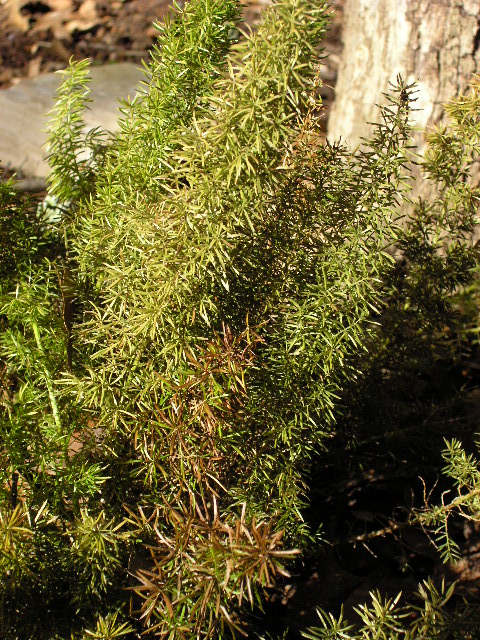
Of the two Foxtail Ferns (Asparagus densiflorus 'Meyersii'), one is potted and one is in the ground.  The protected potted one received minor damage whereas the unprotected soil-based one certainly has more of its stems showing the tell-tale brownish tint that likely will lead to that portion being lost.  But the plant should pull through.
Last year's 18 degree low hammered the Lily of the Nile (Agapanthus africanus) almost completely back to its roots.  So this years lengthy freeze (and 17 degree low) will certainly cause a repeat of last year's results.

Also a repeat low temperature victim is the Pink Rain Lilies (Zephyranthes rosea).  Their foliage typically withstand lows in the mid-20s, but temperatures in the teens lead it to lose everything above ground.  But spring should see it sprouting once again.

A couple of others that appeared a little upset with the cold, but have survived with only minimal damage include Joe Pye Shrub & Cast Iron Plants (Aspidistra elatior).

Of course, there are several other plants that did as expected.  Evergreens continued on in their foliar ways.  Deciduous plants had lost their leaves long ago.  The usual perennial culprits disappeared back into the ground, but will return with the spring.  Likely, some that presently appear undamaged will begin to show signs as the months progress, and others that looked to have received mortal blows will bounce back.

For now, its a waiting game.

Wednesday, February 2, 2011

There Will Be Damage

Many central Texas gardeners looked at last winter's 18 degree low as extreme.  So I guess this winter's freezing temperatures will have to be considered extremely extreme.  Not only have we reached 17 degree lows, but will achieve it two nights in a row.  While it is not uncommon for this area to drop pretty low, we typically bounce back to above freezing quite fast - often on the same day.  This winter is unusual for us as we are expected to remain under freezing for an extended period: over 60 continuous hours at or below freezing.


So there will be damage.  Prior to last night's freeze, I had already covered the plants (even purchasing a 10x20 foot cold cover to add to my collection of sheets, blankets & towels).  Obviously, I don't have enough to cover everything, so choices had to be made.


Covered plants include:
Then there is the inevitable plant that one forgets to cover.  This time around it was the Gasteraloe 'Midnight' - will have to wait and see what happened to it.

But several plants are already showing signs of damage.

Gold Dust Plant (Aucuba japonica 'Variegata')

 Bear's Breech (Acanthus 'Summer Beauty')

Formosa Red Azalea (Azalea indica 'Formosa Red')

Joe Pye Shrub

There are many others (but I was too wimpy to stay out in the cold taking snapshots!).  Even the Cast Iron Plants (Aspidistra elatior) have an unusual darkness to their green color.  Only time will tell which plants survive.

Planted in Pots:

Sunday, January 16, 2011

Foliage Follow-up: January 2011

Foliage Follow-up is sponsored by the Digging garden blog on the sixteenth of every month, where we get to celebrate the leafy aspects of our gardens.  On this dreary, drippy day, I decided to concentrate on the few plants I have that tend to disappear in our summer's heat but make a return in the coolness of winter.

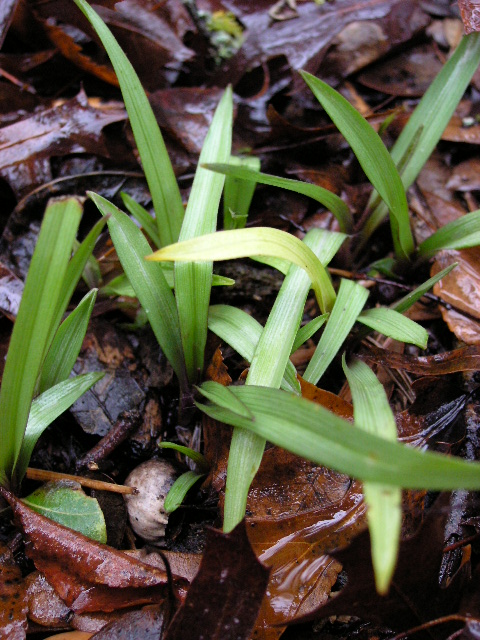
Though only starting to peak out from the leaf litter, the Sweet Kate Spiderwort (Tradescantia x andersoniana 'Sweet Kate') has begun to produce some green amongst the brown.  It will primarily shine during the spring, but will fade once things get hot and dry.

Considered by many to be invasive, I threw caution to the wind this past spring and added White Shamrock (Oxalis crassipes 'Alba') to my garden.  It completely disappeared in the summer, but has been coming back strong this winter.

Back in mid-September, from the bare ground, up shot my first Red Spider Lily (Lycoris radiata) bloom.  I'm hoping for plenty more blossoms next fall as the bulbs are producing good foliage this winter.

After almost completely disappearing over the summer, Bear's Breech (Acanthus 'Summer Beauty') always comes on strong once the temperatures start dropping.  Its huge leaves make an impressive show (though recent low temperatures have wilted the plant a little).

Another plant that is completely lacking vegetation in the summer, the Oxblood Lily (Rhodophiala bifida) is once again making its presence known.  Planted only last March, I have yet to get any blooms but hope some will make an appearance this fall.

Wasn't sure if my spring-planted Heartleaf Skullcap (Scutellaria ovata) had made it through the summer heat.  Winter and early spring should be its time to shine, but I'm not completely confident with it yet.

Though present year-round, the Burgundy Glow Ajuga (Ajuga reptans 'Burgundy Glow') does add quite a bit to the winter color.  The burgundy coloration intensifies and spreads during the colder temperatures and makes it quite eye-catching. 

Be sure to visit Digging to see the foliage that other gardeners are sharing from their winter gardens.

Tuesday, January 4, 2011

Shady Happenings

Over the past couple of weeks, my time in the garden has been limited.  But I did notice a few "happenings" when I was able to be out amongst the plants.

With the cooler weather, the Bear's Breech (Acanthus 'Summer Beauty') has certainly come back from it's summer doldrums.  It's pot has been hidden away under some shady Yaupons and Live Oaks where it has been busy putting out new leaves.  It got moved out on to the deck so that it can be better appreciated.

The deck is pretty bare as most of the potted plants have been hidden away from the colder weather in either the garage or the new pop-up greenhouse.  Though freezes have been few and light (scary ones are predicted for next week), a check on the greenhouse plants shows they are doing just fine in their new housing.

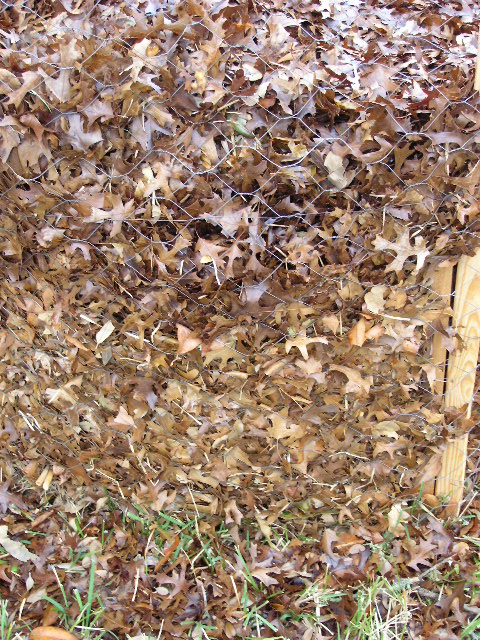
Most of the deciduous trees are now bare of leaves, but I have been busy gathering them up off my lawn by using my mulching lawnmower to shred and capture them.  Each session would fill my experimental compost bin to its top, followed by it quickly settling and compacting - so that additional room was always available for the next gathering.

Noticed that this method led to varying colored strata - though the plant species' leaves gathered each time were the same.  I'm just assuming that the color is more an aspect of the aging and decomposition phases.

Did find time over the holidays to build some wooden shelves for one side of my garden shed.  The other side has two flimsy plastic shelves which I hope to replace with identical 3-level wooden shelves.  This should increase the storage capacity of the shed and allow me to make more efficient use of its space.


Just a little bit here, and a little bit there.

Saturday, May 15, 2010

Flower Power: GBBD May 2010

May Dream Gardens hosts Garden Blogger's Bloom Day every month.  Blooms in my May shady garden tend to be scattered individuals, but its still fun to see the small splashes of colors.  Here's what is blooming in my garden:

New Plants in the Garden

Anthony Waterer Spirea (Spiraea x bumalda 'Anthony Waterer') may need a little more sun and acid than it is getting presently, but it still put out a few clusters of flowers.

Goldmound Spirea (Spiraea japonica 'Goldmound') still has a few faint pink clusters also.

Dyckia fosteriana, growing right at the base of a Red Oak, produces blossoms that are actually more orange than shown in the picture.

Pink Shamrock (Oxalis crassipes 'Rosea') is constantly producing additional little pink blooms.

My other shamrock, White Shamrock (Oxalis crassipes 'Alba'), doesn't seem to make as many blooms, but still manages to put out some.

Established Plants

Texas Betony (Stachys coccinea) has finished its primary bloom cycle, but still has a few blossoms here and there.

Cedar Sage (Salvia roemeriana) continues to throw out vertically challenged bloom stalks.

'Ragin' Cajun' Ruellia (Ruellia elegans 'Ragin' Cajun') has re-emerged from underground; still getting this year's growth started, it also managed to throw out a couple of blooms.

If my memory is correct, Red Dragon Knotweed (Persicaria microcephala 'Red Dragon') mainly produces its blossoms in the fall.  But a few are appearing here in the spring.

Yeah, I know.  It's bad, it's evil.  But Nandina domestica grows & blooms in my shade, and its red berries in the fall are lovely. 

Annual

The bronze-leafed begonias (Begonia x semperflorens-cultorum) continue to explode in pink blossoms.  I'm not too big on annuals, but I can't pass up the begonia's zealous bloom production.

Potted Plants

The Chrysanthemum still puts out a flower now and again.

The Red Yucca's (Hesperaloe parviflora) bloom stalk has skyrocketed upward, and is now unfurling its limbs of red blooms.

Bear's Breech (Acanthus 'Summer Beauty') is sending up two flower spikes which tend to last quite a while.  The unique blossoms occur at almost symmetrically precise steps along the stalk.

Hope you are enjoying your own bloom day!